Last updated: June 17, 2026
Shopping for a manual espresso machine is confusing for one reason nobody says out loud: the word “manual” covers three completely different machines. A lever press you push down with your arm, a hand pump you squeeze on a campsite, and a spring lever that sits on a counter like industrial sculpture all get filed under the same label, and they suit very different people. Buy the wrong family and the machine becomes a shelf ornament.
This guide splits the category honestly and gets to the part most product pages skip: with manual espresso, the grinder usually decides whether you succeed, not the machine. It also covers portafilter sizes, water heating, preheating, and the learning curve that catches first-time buyers off guard.
This article contains affiliate links. If you buy through them, we may earn a commission at no extra cost to you. Learn more.
Quick Answer
Which manual espresso machine should you buy?
- For a kitchen counter and full control, a lever press with a built in pressure gauge and a handled portafilter is the most rewarding starting point.
- For travel and camping, a hand pump maker with an insulated water chamber is the only type that genuinely fits in a bag.
- For heat stability and back to back shots, a lever machine with its own boiler does far more of the work for you, at a much higher price level and a larger footprint.
What to Check Before You Buy
Eight things decide whether a manual machine fits your kitchen and your patience. Most disappointment here traces back to one of these rows being ignored, usually the grinder line at the bottom.
| What to check | Why it matters | What to look for |
|---|---|---|
| Lever type | Decides how much technique the machine asks of you | Lever press for control, hand pump for travel, spring lever for repeatable pressure |
| Pressure source | Espresso needs high pressure, and something has to supply it | Your arm (press and pump) or a calibrated spring; a built-in gauge makes the difference visible |
| Portafilter size | Governs which baskets, tampers, and distribution tools fit | 58 mm is the common standard with the widest accessory choice; smaller sizes limit your options |
| Basket capacity | Sets your dose and whether doubles are realistic | Travel units are often single-shot sized; countertop presses usually take a normal double basket |
| Water heating | Manual machines rarely heat water themselves | Kettle-fed models let you control temperature exactly; built-in heating trades control for convenience |
| Preheat needs | Cold metal pulls heat out of the shot instantly | Metal group and portafilter should be rinsed with hot water first; check how quickly the unit sheds heat |
| Portability | Only one family is truly packable | Hand pumps travel; lever presses are countertop tools; spring levers are furniture |
| Grinder requirement | Espresso needs a fine, adjustable, even grind | An espresso-capable burr grinder is not optional here, so budget for it from the start |
The Three Families of “Manual”
Manual means the pressure comes from you or from a spring, not a motorized pump. Beyond that shared idea, the three families behave nothing alike, so pick your family before you pick a model.
Lever press: maximum control, no electricity
You load the portafilter, add hot water, and push a lever down. Your arm builds the pressure, so you can shape the whole shot: a gentle start for pre-infusion, a firm middle, an easing off at the end. That is control no entry-level pump machine offers, though it also means every shot depends on your consistency. No outlet is required, which makes these popular for small kitchens and off-grid setups.
Hand pump: built for the road
These are small cylinders you pump by hand, usually with an insulated chamber for hot water and a single-shot basket. Owners report results can be genuinely good for the size, but doses are small and the routine is fiddly next to a countertop unit. Buy this family for espresso in a tent or a hotel room, not as a cheap door into espresso.
Spring lever: the machine does the pressure
You cock the lever, a calibrated spring releases, and it delivers a pressure curve that repeats far more reliably than an arm can. The trade-off is size, weight, and price: these are large, heavy, premium objects that need real preheating time before the first shot of the day.
Why the Grinder Matters More Than the Machine
Espresso means forcing hot water through a tightly packed bed of very fine coffee at high pressure, with around 9 bar commonly cited as the reference point. That only works if your grind is fine, even, and adjustable in small steps. Pre-ground coffee and blade grinders cannot deliver it, and no lever can fix that.
This ruins more manual setups than anything else. A hand grinder without espresso-capable burrs cannot go fine enough consistently, and the result is fast, thin, sour shots. Plan the grinder in from day one; our guide to the best manual coffee grinders flags which models handle the espresso range and which top out at pour over.
Our Top Picks at a Glance
How we chose: we sorted the available manual machines by family, then weighed pressure control, portafilter standard, basket capacity, preheating behavior, and how forgiving each type is for a beginner. Selections lean on manufacturer specifications and themes that repeat across owner reviews rather than any hands-on trial of our own.
One reassurance before the list: the first three picks need no power outlet at all, so a kettle is all you need, and each is a tool you can learn on rather than a novelty.
🏆 Best Overall
A countertop lever press with a built-in pressure gauge and a handled portafilter. The gauge turns an invisible skill into something you can read and repeat, so a good shot becomes a number you can aim at again tomorrow.

🎒 Best for Travel
A hand pump maker sized for a bag, with a single-shot basket and a hand pumped chamber that builds real pressure. Needs no power, so a kettle or camp stove is the whole setup. Expect a small dose, not a full double.

💰 Best Budget Pick
A compact stainless lever maker that skips the gauge and keeps the mechanism simple. The most affordable honest entry into pressure brewing, provided you already own, or will buy, a grinder that goes fine enough.

Who Should Not Buy a Manual Machine
If you want a shot ninety seconds after waking up, this is the wrong category. Manual espresso asks for grinding, preheating, dosing, tamping, and a pull you actively steer. Some people find that the best part of the morning; others find it a chore by week two.
If that sounds like you, a pump machine is the better tool. A semi-automatic espresso machine keeps the interesting decisions (dose, grind, timing) while handling pressure for you, and a compact espresso machine does the same in a smaller footprint. Both remove the arm technique without removing the craft.
Two More Picks: Upgrade and Everyday Alternative
The three picks above cover most buyers. These two sit at the edges: one for people who want the mechanism to guarantee consistency, one for people who want concentrated coffee without the pressure requirement.
⭐ Upgrade Pick
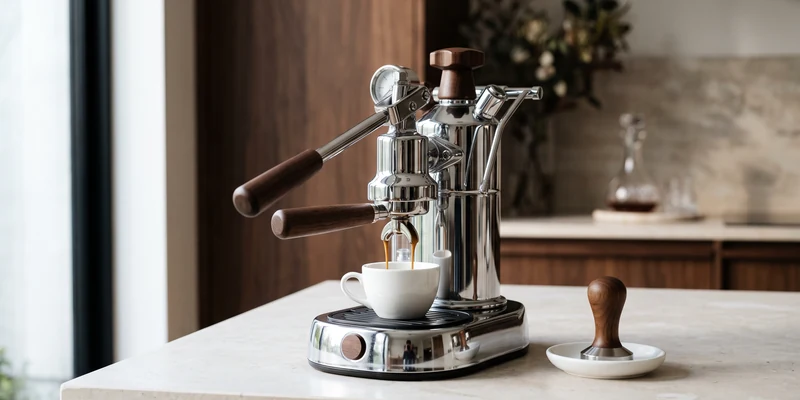
A lever machine with its own heated boiler, a brass and copper body, and a bottomless portafilter. The boiler holds temperature through back-to-back pulls instead of leaning on a kettle, and the long lever gives a smooth, repeatable pull once your technique settles. Premium territory, in size as well as price level.

☕ Also Great
The honest caveat comes first: this classic press makes a strong, concentrated cup, not true espresso, because it does not reach espresso pressure. What it offers is a forgiving routine, easy cleanup, and travel-friendly durability. Our piece on whether an AeroPress can make real espresso explains where the line sits.

Pulling Your First Shots
Expect the first several shots to be bad, and treat that as normal rather than a defect. Manual espresso stacks four variables (grind, dose, tamp, pressure) that all interact, so change one thing per shot and note what you did.
Heat and preheating
You control the water temperature yourself here, which is an advantage once you use it. The commonly recommended range for hot brewing is 195 to 205 F (about 91 to 96 C), and letting boiled water rest for roughly 30 to 45 seconds usually lands you inside it. Just as important: run hot water through the group and portafilter first, because cold metal steals heat from a small shot at once.
Dose, tamp, and pressure
Fill the basket level, then tamp flat and firm; an uneven bed lets water carve a channel and ruin the extraction before you start pushing. A dedicated tamper that matches your basket makes this far easier than the plastic disc most machines include, and our guide to the best espresso tampers covers sizing. Then build pressure gradually, so the soft start acts as pre-infusion and wets the puck evenly.
Common Mistakes to Avoid
- Budgeting for the machine and forgetting the grinder. A grinder that cannot reach espresso fineness will never produce espresso. Treat it as part of the purchase, not an accessory.
- Skipping the preheat. Cold metal drops the brew temperature the moment water touches it. Rinse group, portafilter, and cup with hot water first.
- Slamming the lever. Sudden full force blows a channel through the puck. Ease into the pull and let the gauge or the resistance guide you.
- Assuming portable equals easy. Hand pumps are made for travel, not convenience. At home, a countertop press is less fiddly.
- Quitting after three shots. The curve is real but short. Most owners describe things clicking once they stop changing several variables at once.
Where to Go From Here
If the manual route sounds like more ritual than you want, look at the pump side before you commit. Our roundup of the best value espresso machines is the most useful next stop, because it weighs what you get for the money across the whole category rather than within one family. The budget espresso machine guide covers the entry tier honestly, including what gets left out.
If you already want a pump machine with a broad accessory ecosystem, the Breville espresso machine guide compares that lineup model by model.
Frequently Asked Questions
Can a manual espresso machine make real espresso? Yes, lever presses, hand pumps, and spring levers all generate genuine espresso pressure, with around 9 bar commonly cited as the reference point. The result still depends heavily on your grind and technique.
Do I need a special grinder for manual espresso? You need one that grinds fine, evenly, and in small adjustable steps. Many hand grinders top out too coarse, so check the espresso range before buying; our manual grinder guide covers which ones qualify.
What portafilter size should I look for? 58 mm is the most common standard and gives the widest choice of baskets, tampers, and distribution tools. Smaller proprietary sizes work fine, but they narrow your accessory options.
Is a manual machine a good first espresso machine? It can be, if you enjoy the process and will invest in a proper grinder. If you mainly want a fast, repeatable shot, a semi-automatic machine is the more comfortable starting point.
The Bottom Line
The best manual espresso machine is the one that matches how you will use it: a lever press with a gauge for the counter, a hand pump for the road, and a boiler equipped lever machine if you want heat stability across back-to-back shots. Settle the grinder question first, because a grind that cannot reach espresso fineness limits every machine above it. And if the ritual sounds like work rather than pleasure, a pump machine will make you happier.