Last updated: August 13, 2026
Breville built the ladder that most home espresso drinkers climb, which is exactly why choosing between the models gets confusing. The best Breville espresso machine for your kitchen has less to do with which one is newest and more with two questions you can answer in a minute: do you want the grinder inside the machine, and how involved do you want to be when you steam milk.
This guide narrows the range to five machines that come up again and again in owner discussions, then explains the differences that change your morning: built-in grinding versus a separate grinder, how quickly the machine is ready, manual versus automatic milk, and the details nobody mentions until you own one.
This article contains affiliate links. If you buy through them, we may earn a commission at no extra cost to you. Learn more.
Quick Answer
Which Breville espresso machine should you buy?
- For most first-time buyers the Barista Express is the sensible default: grinder, portafilter, and steam wand in one box, so you can pull shots the day it arrives.
- If counter space is tight or you already own a good grinder, the Bambino and the Infuser give you the espresso half without the bulk.
- If milk drinks are the whole point and you would rather not texture by hand, the Bambino Plus automates that step.
The Breville Espresso Lineup Compared
Five machines cover the range that most home buyers actually consider. Two of them include a grinder, three do not, and the milk system is the second dividing line.
| Model | Best for | What sets it apart | Keep in mind |
|---|---|---|---|
| Barista Express | One machine that does everything | Built-in conical burr grinder that doses straight into the portafilter | The largest footprint of the group, and the grinder adds its own cleaning routine |
| Barista Pro | Buyers who want the same all-in-one with fewer waits | Breville’s ThermoJet heating system plus an LCD shot display | Still a manual steam wand, so milk technique is on you |
| Bambino | Small counters and simple setups | Compact body with ThermoJet heating and no grinder inside | You need a separate grinder, plus a home for it |
| Bambino Plus | Milk drinks without the learning curve | Automatic milk texturing with selectable temperature and foam levels | Same compact tank and still no grinder |
| Infuser | Owners who already grind their own | Manual steam wand with low pressure pre-infusion and volumetric shot control | Uses an older style heating system, so it is less of a grab and go machine |
Notice what is not in that table: pressure numbers and boiler marketing. Those specs look decisive on a product page, but footprint, grinder, and milk workflow are what decide whether you enjoy the machine.
Grinder Built In, or a Grinder of Your Own?
This is the first fork in the road. The Barista Express and Barista Pro include a conical burr grinder that doses directly into the portafilter. The Bambino, Bambino Plus, and Infuser leave grinding to you, which means a second purchase but usually a better grind.
Why an all-in-one still makes sense
A single machine means one plug, one cleaning routine, and no counter negotiation. For someone moving from pods to real espresso, the Barista line removes the biggest reason people give up early: buying a machine and then discovering that supermarket pre-ground coffee will not produce a decent shot no matter how carefully you tamp.
Why a separate grinder usually grinds better
Baristas generally recommend putting money into the grinder before the machine, because espresso is unusually sensitive to grind consistency. A dedicated grinder gives you finer adjustment steps, which makes it easier to dial a shot in when you change beans. If you are pairing a Bambino or an Infuser with a first grinder, our Baratza Encore review covers a widely owned starting point, and a flat, well-sized tamper helps more than beginners expect, as explained in our guide to the best espresso tampers.
Heat-Up, Milk, and Baskets: What Really Separates the Models
Once the grinder question is settled, three smaller decisions do the rest: how the machine heats, how it handles milk, and which baskets you plan to use.
ThermoJet versus older heating
The Barista Pro, Bambino, and Bambino Plus use Breville’s ThermoJet system, which the company positions as a fast-heating alternative to the thermoblock in earlier models like the Barista Express and the Infuser. That difference shows up as a shorter wait between switching on and pulling a shot. If your mornings are rushed, it matters; if you switch the machine on and go get dressed, much less so.
Manual wand or automatic milk
The Barista Express, Barista Pro, Bambino, and Infuser all use a manual steam wand, so texturing microfoam is a skill you build. The Bambino Plus automates it: you pick a temperature and a foam level, drop the wand in the pitcher, and it stops on its own. Owners who mostly drink lattes often report that this single feature is what made the machine stick. If standalone frothing appeals instead, our Breville milk frother review looks at that route.
Pressurized and non-pressurized baskets
Breville ships this lineup with both dual wall (pressurized) and single wall (non-pressurized) baskets. Pressurized baskets create backpressure artificially, which forgives an imprecise grind and works reasonably with pre-ground coffee. Single wall baskets forgive nothing, but they are where the better shots live once you have a grinder you can adjust. Note that this lineup uses a 54 mm portafilter rather than the 58 mm size found on commercial machines and Breville’s dual boiler tier, so buy accessories in the right size.
Our Top 5 Breville Espresso Machines
How we chose: we compared the widely available Breville models on grinder integration, heat-up approach, milk system, counter footprint, and the themes that repeat across owner feedback and manufacturer specifications.
🏆 Best Overall
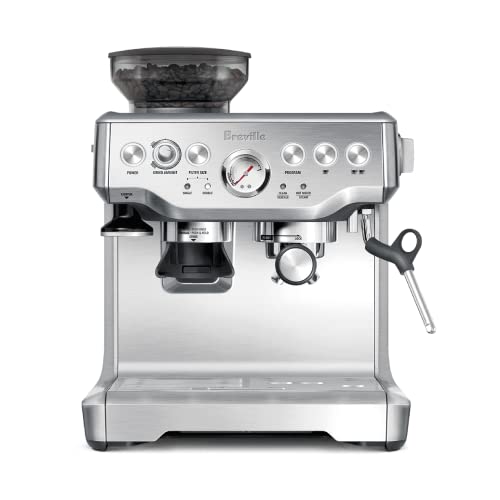
The Barista Express is the default recommendation for a reason: grinder, portafilter, and steam wand in one machine, with enough adjustment to keep improving for years. It is the least complicated way to go from no setup at all to real shots at home.
✅ Grinder, machine, and steam wand in a single purchase
❌ The biggest footprint of the five, and grinder cleaning is part of the deal
⚡ Best Fast-Start Upgrade
The Barista Pro is the same all-in-one idea with ThermoJet heating and an LCD that walks you through the shot, which suits anyone whose coffee happens in a hurry.
✅ Quicker from switch-on to first shot, with a clearer display
❌ Costs more than the Express for a similar core feature set

📦 Best for Small Counters
The Bambino strips espresso down to the essentials in a body narrow enough for an apartment kitchen, with fast heating and a manual steam wand. Pair it with a grinder you choose yourself and you get a capable setup in little space.
✅ Compact, quick to heat, and easy to tuck under a cabinet
❌ No grinder inside, and the water tank is small enough to need regular refills

Two More Breville Machines Worth Considering
Two situations deserve their own answer: households that live on milk drinks, and coffee people who already own a grinder they like.
🥛 Best for Hands-Off Milk
The Bambino Plus adds automatic milk texturing to the compact Bambino body, with selectable foam and temperature settings. If lattes are the daily order and nobody in the house wants to practice steaming, this model removes the friction.
✅ Consistent milk without technique, in a small footprint
❌ You still need a separate grinder, and automation means less control over texture

🔧 Best If You Already Own a Grinder
The Infuser gives you low pressure pre-infusion, volumetric shot control, and a manual steam wand without paying for a grinder you do not need. It is the quiet choice for anyone building around a grinder they already trust.
✅ Real shot control at a lower entry point than the Barista line
❌ Older heating design, so it wants a longer warm-up before the first shot

Counter Space, Water Access, and Daily Upkeep
Two checks prevent most regret here. Measure your counter depth including the space behind the machine, and look at where the water tank sits, because several Breville models fill from the back. Under a low cabinet, that turns a quick refill into a daily annoyance.
Cleaning is a schedule, not an event
Every espresso machine asks for two routines: backflushing with a cleaning tablet to clear coffee oils from the group, and descaling to deal with mineral buildup. Breville machines prompt you when a cycle is due, and skipping those prompts is the fastest way to shorten a machine’s life. Our walkthrough on how to descale a Breville espresso machine covers the process, and Breville cleaning tablets and filters explained sorts out the consumables.
Small habits that keep shots consistent
Wipe and purge the steam wand after every milk drink, knock out the puck promptly, and rinse the group before you brew. Filtered water reduces how often you descale. None of it takes long, but it separates a machine that still behaves in year three from one that slowly drifts.
Common Mistakes to Avoid
- Buying the machine and skipping the grinder. A capable machine fed pre-ground coffee will disappoint you. If you choose a Bambino or an Infuser, budget for grinding too.
- Assuming the pressurized basket is the only option. The dual wall baskets are a training aid. Once your grinder adjusts finely, switch to single wall.
- Ignoring where the water tank sits. Rear-fill tanks under a cabinet mean pulling the machine out every day. Check before you order, not after.
- Treating descaling as optional. Mineral buildup is a common reason home machines fail early, and hard water accelerates it. Follow the prompts.
- Paying for automatic milk you do not want. If you drink espresso and americanos, the Bambino Plus buys a feature you will rarely use.
Where to Go From Here
Still deciding on a category rather than a model? Our guide to semi-automatic espresso machines explains what this class asks of you and what it gives back. Working with a small kitchen? The compact espresso machine roundup compares narrow-body options across brands. And if you suspect you will eventually want brewing and steaming at the same time, read up on the dual boiler tier before you spend twice.
Frequently Asked Questions
Is the Barista Express still worth buying? For a first real espresso setup it remains one of the most straightforward answers available, because the grinder is included and matched to the machine. The Barista Pro is the choice if faster heat-up and a clearer display are worth the step up.
What is the difference between the Bambino and the Bambino Plus? The Plus adds automatic milk texturing with temperature and foam settings; the standard Bambino uses a manual steam wand. The rest, including the compact body and the absence of a grinder, is closely related.
Do I need a separate grinder for a Breville espresso machine? Only for the models without one: the Bambino, Bambino Plus, and Infuser. Some Barista owners still add a dedicated grinder for more adjustment range, as discussed in our Baratza Encore review.
How often should I descale a Breville machine? Follow the machine’s own prompt, which adjusts to your usage, and descale sooner if your water is hard. The process is covered in our guide on descaling a Breville espresso machine.
Can I use pre-ground coffee in these machines? Yes, with the pressurized dual wall baskets, which is why Breville includes them. Results improve once you grind fresh and move to single wall baskets.
The Bottom Line
The Barista Express is still the most complete starting point in the Breville range, with the Barista Pro as the faster-heating version of the same idea. Choose the Bambino or the Infuser if you already own a grinder or your counter is short on space, and the Bambino Plus if automatic milk is what will keep you using the machine.