Last updated: August 13, 2026
A manual coffee grinder buys you burr quality that would cost noticeably more in an electric machine, because you are paying for steel and bearings instead of a motor and a housing. It is also silent, needs no outlet, and fits in a backpack. The trade is simple and unavoidable: your arm does the work the motor would have done.
This guide treats hand grinders as machines. What the burrs are made of, where the adjustment sits, whether the shaft stays centered under load, and how much of the grind range you actually get: those four things separate a grinder you keep for years from one that ends up at the back of a cabinet.
This article contains affiliate links. If you buy through them, we may earn a commission at no extra cost to you. Learn more.
Quick Answer
Which manual coffee grinder should you buy?
- For most home brewers: stainless conical burrs and a shaft supported by two bearings. The Timemore Chestnut C3 is the reference point in that class.
- On a tight budget, ceramic burrs like those in the Hario Slim Plus handle drip and French press well, if you accept slower grinding and coarser adjustment steps.
- If espresso is the goal, buy for that specifically. You need a genuinely fine setting and the patience to turn for it.
What to Check Before You Buy
Eight specifications decide how a hand grinder feels in daily use. Product pages rarely list all of them, so treat any gap as a question worth answering before you order.
| What to check | Why it matters | What to look for |
|---|---|---|
| Burr material | Decides how beans are broken and how burrs age | Steel for speed and fine grinding; ceramic as the budget option |
| Adjustment type | Sets how easily you switch brew methods | An external ring on the base or cap; internal nuts mean disassembly |
| Axle support | A wobbling shaft lets the burr drift off center | Two bearings, described as double or dual bearing |
| Grind range | Not every grinder covers coarse and fine well | Confirm it spans your methods; espresso capable is a separate claim |
| Capacity per fill | Sets how many refills a brew takes | Enough for your usual dose in one load, especially for press |
| Body and grip | You hold this while applying force | Aluminum or steel with a textured or silicone grip; glass slips |
| Travel friendliness | Handles and hoppers are what snag in a bag | A removable or folding handle, a body that fits inside a press |
| Cleaning | Old grounds stale and dull the flavor | Burrs that come out without tools; a brush that reaches the threads |
Burrs and the Shaft That Holds Them
Burr material and shaft support are the two mechanical facts that predict how a hand grinder performs. Everything else, including looks and catch cup design, is comfort.
Ceramic or stainless steel
Ceramic burrs are hard and inexpensive, and they are what most entry level grinders use. Their edges are typically blunter than steel, so they crush beans as much as they slice them, which means more turning effort and, at fine settings, a wider spread of particle sizes. Stainless burrs cut more aggressively, chew through a dose faster, and generally hold a cleaner line when the gap gets small. Ceramic resists corrosion; steel is easier to machine into the sharp geometry that fine grinding rewards.
Neither material fails on a predictable schedule, and any brand promising an exact lifespan is guessing. Dulling shows up as a symptom rather than a date: grinding gets harder, the same setting brews weaker, fines increase. That is the signal to replace the burr set.
Why the shaft matters
The central shaft holds the inner burr in the middle of the outer burr. Supported at only one point, it can tilt slightly as you turn, making the gap wider on one side than the other. At coarse settings you may never notice. At pour over and espresso settings, where the gap is already small, that wobble is the difference between a grinder that feels precise and one that feels frustrating. Two bearings is the fix, and it is worth searching the product description for it.
Adjustment: Internal, External, Stepped or Stepless
Adjustment design decides whether switching brew methods takes five seconds or five minutes. Internal adjustment is cheaper to build and lives under the burr, so you lift off the handle and hopper and turn a nut. External adjustment puts a numbered ring on the base or under the cap, which you turn with the grinder fully assembled.
If you brew one way every morning, internal adjustment is a minor annoyance you set once and forget. If you alternate between a weekend French press and weekday pour over, an external ring is what keeps you from giving up and picking one grind. Stepped adjustment moves in audible clicks, which makes settings repeatable. Stepless slides continuously, giving finer espresso control but asking you to remember where you were. For most people, clicks win.
Our Top Picks at a Glance
How we chose: we compared widely available hand grinders on burr material, adjustment design, shaft support, usable grind range, and capacity. Selections lean on manufacturer specifications and the themes that repeat across owner reviews rather than any hands on trial of our own.
One reassurance before the list: none of these are fussy or fragile. The differences below are about range and effort, not about whether they work.
🏆 Best Overall
CNC stainless conical burrs and a double bearing shaft, in a slim metal body with a grippy sleeve. It grinds a single dose quickly enough that the effort stops being a talking point.

💰 Best Budget Pick
Ceramic burrs and a slim body with a footprint small enough for a desk drawer. Adjustment is internal and the steps are coarse, so treat it as a capable drip and press grinder rather than a do everything tool.
🫗 Best for French Press
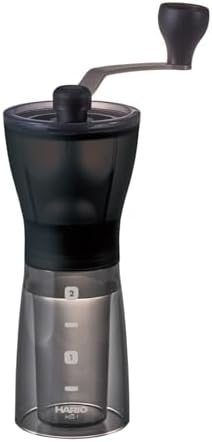
A ceramic burr grinder with a 60 gram capacity, which matters because press doses are big and coarse grinding is where hand grinders are quickest. Our French press grinder guide compares the field in detail.

How Much Work Is Hand Grinding, Really?
Effort scales with two things: how fine you grind and how much you grind. Coarse settings for a press or cold brew go quickly, because the burrs remove a lot of material per rotation. Fine settings take far longer, since the gap is small and each turn does less. Dose multiplies whatever that rate is.
So you can predict your own experience. A single pour over is a short task most mornings. A large press dose is easy but takes a while. Espresso fine, by hand, is genuine work, which is why people who pull shots daily either buy an electric grinder or commit to a hand grinder built for it. If lever shots are the plan, read the pairing question in our guide to manual espresso machines first.
Grind Range by Brew Method
The most important buying criterion is whether a grinder covers the settings you actually brew at. These are the commonly recommended ranges, and no hand grinder covers all of them equally well:
- Espresso. Fine, and the hardest setting to reach and hold on a hand grinder.
- Moka pot. Fine to medium fine, comfortably within reach of most steel burr grinders.
- Pour over. Medium to medium fine, often compared to table salt. This is where shaft stability shows up most clearly, and where a good hand grinder improves the cup from a pour over brewer.
- Drip. Medium, the easy middle of any grinder’s range.
- French press and cold brew. Coarse, and for cold brew often coarser still. Capacity matters more than precision, as our cold brew grinder guide covers.
- Turkish. Powder fine, which most hand grinders will not reach. That job belongs to a dedicated Turkish grinder.
Two More Picks: Finer Grinds and Life on the Road
The three picks above cover most kitchens. These two answer what comes next: how far you can push fineness by hand, and what survives a suitcase.
⭐ Upgrade Pick
An external adjustment ring plus stainless burrs rated for espresso, which in practice means tighter tolerances and a shaft that holds position under load. Worth it if one grinder has to cover espresso and pour over, and you accept the extra turning.

🎒 Best for Travel
A compact stainless body with a crank that folds down, so it packs flat and stops catching on everything in your bag. The natural partner for an AeroPress in hotel rooms, campsites, and office desks.

Keeping a Hand Grinder Working
Hand grinders stay good with almost no maintenance, but they need the right kind. Brush the burrs and threads regularly, because old grounds collect behind the outer burr and stale oils dull the flavor of everything you grind afterward.
Keep water away from steel burrs. Never force the handle if the grinder jams: back the adjustment off a step, clear the obstruction, reset. If a setting that used to work suddenly brews thin, check for a loose adjustment nut before blaming the coffee.
Common Mistakes to Avoid
- Buying on burr size alone. A large burr on a wobbling shaft grinds worse than a smaller burr held straight. Check the bearings before you compare millimeters.
- Assuming every grinder does espresso. Many bottom out well before a true espresso fine setting, or reach it with too little precision to be useful. Look for the claim explicitly.
- Ignoring capacity. If your usual brew needs two full loads, you will grind less often than you planned. Match the catch cup to your dose.
- Internal adjustment in a multi method kitchen. Disassembling the grinder every time is what makes people stop switching grinds altogether.
- Skipping the brush. Grounds packed behind the outer burr shift your effective setting. Two minutes a month prevents it.
Where to Go From Here
If daily espresso or large batch brewing is in your future, the honest next step is an electric burr grinder rather than a bigger hand grinder, and the Baratza Encore review covers the machine most people land on for filter brewing. If you are staying manual, spend the rest of your budget on the brewer: a solid hand grinder plus a well made dripper beats an expensive grinder feeding a mediocre one.
Frequently Asked Questions
Are manual grinders as good as electric ones? At a similar price a hand grinder usually has better burrs, because none of the budget goes to a motor. Electric grinders win on speed, large doses, and daily convenience.
Ceramic or stainless steel burrs? Steel cuts faster and generally performs better at fine settings; ceramic is inexpensive and corrosion resistant. For drip and press brewing, ceramic is perfectly serviceable. For espresso, steel is the sensible choice.
How long does it take to grind a cup by hand? It depends on dose and fineness far more than on brand. Coarse grinding for a press is quick, pour over settings are a short task, and espresso fine takes considerably longer with any hand grinder.
Can a manual grinder do espresso? Some can, but only models that specifically claim espresso capability with tight adjustment and a well supported shaft. General purpose grinders often cannot reach a usable espresso setting.
Is a hand grinder good for French press? Yes, and it is the easiest job you can give one, since coarse settings grind quickly. Check capacity, because press doses are larger than single cup doses.
The Bottom Line
The right manual coffee grinder is the one whose grind range covers the way you actually brew, built around steel or ceramic burrs on a shaft held by two bearings. External adjustment keeps a multi method kitchen honest, and capacity is the spec people underestimate. Be realistic about turning effort at fine settings and the rest is straightforward.