Last updated: April 22, 2026
Buying an espresso tamper looks like the easiest decision in your coffee setup, right up until you realize the wrong one by a millimeter or two quietly ruins every shot you pull. A tamper that is too small leaves a ring of loose grounds around the edge of the basket, water rushes through that gap, and the shot runs thin and sour no matter how carefully you dialed in the grinder. Size is not a detail here. Size is the decision.
This guide sorts the category the way it actually matters: the diameter and how to measure your own basket instead of trusting the box, then flat versus convex bases, then whether a calibrated model is worth it for you. Handle, weight, and the small piece of silicone that saves your countertop follow, and the picks at the end cover the four situations most home baristas fall into.
This article contains affiliate links. If you buy through them, we may earn a commission at no extra cost to you. Learn more.
Quick Answer
Which espresso tamper should you buy?
- Measure your portafilter basket first. Most prosumer machines take a 58mm family tamper, and Breville home machines with a 54mm portafilter want a tamper around 53.3mm.
- For repeatable results without thinking about it, a spring-loaded calibrated tamper such as the Normcore 58.5mm removes most of the guesswork.
- A plain stainless flat-base tamper in the right diameter still works beautifully, as long as you tamp the same way every single time.
What to Check Before You Buy an Espresso Tamper
Almost every buying mistake here traces back to one of six things, and five are visible on the product page if you know what to look for. Check the first row twice, because a tamper in the wrong diameter is not a compromise, it is a return.
| What to check | Why it matters | What to look for |
|---|---|---|
| Base diameter | Gaps at the edge let water bypass the coffee bed | Measure your own basket, then pick a base a fraction smaller. 58mm machines usually pair with 58.0mm to 58.5mm; Breville 54mm portafilters with roughly 53.3mm |
| Base shape | Flat and convex distribute pressure differently | Flat is the default and the easiest to judge visually. Convex has a slight dome that some users prefer for edge sealing |
| Calibrated or classic | Consistency between shots is the real variable | Spring-loaded calibrated models click or give at a set point. Classic solid tampers rely entirely on your hands |
| Handle material | Grip and comfort shape how repeatable your tamp is | Wood feels warm, stainless feels solid and cleans easily, textured composite grips well with damp hands |
| Weight and balance | A heavy tamper does some of the work for you | The right one feels planted in your palm without forcing your wrist into an odd angle |
| Base finish and edges | Rough edges drag on the basket wall and mar the puck | Polished stainless with a clean edge; check owner comments about burrs on budget models |
If you are still choosing the machine that tamper will serve, start with the machine guides instead: our roundups of the best Breville espresso machines and the best semi-automatic espresso machines both explain which portafilter sizes you are signing up for.
Why 58mm Became the Standard, and Where Breville Sits
The short version: 58mm is the size the commercial espresso world settled on decades ago, and the home market followed. Most prosumer and commercial group heads take a 58mm portafilter, so accessory makers built their catalogs around it, which is why almost every distribution tool, puck screen, and dosing funnel assumes that number.
The 58mm family is not exactly 58mm
A tamper sold as 58mm has to fit inside a basket that is itself around 58mm, so real products land anywhere from about 58.0mm to 58.6mm depending on the maker and the basket it targets. Slightly oversized bases such as 58.5mm exist because many modern precision baskets have a hair more room than older ones. Neither number is universally correct, which is why the measurement step below is not optional.
Breville machines use a 54mm portafilter
Most Breville home espresso machines, including the popular Bambino and Barista families, use a 54mm portafilter rather than the commercial 58mm. The basket inside is narrower than that outer measurement suggests, so the tamper you want is typically around 53.3mm. Ordering a 54mm tamper because your machine is described as a 54mm machine is one of the most common mistakes in this category, and it simply will not seat. If you own one, our guide to Breville cleaning tablets and filters covers the rest of the accessory ecosystem.
Always Measure Your Own Basket
Take the basket out of the portafilter, set a ruler or caliper across the inside of the rim, and note the number. That measurement, not the number on your machine and not the one on the tamper box, is what matters. Baskets vary between models, production runs, and especially between stock and aftermarket precision baskets.
Then choose a base a fraction smaller so it drops in cleanly without scraping. A little clearance is normal. What you are avoiding is the visible ring of loose grounds at the edge, the classic cause of channeling, where water takes the path of least resistance past most of your coffee.
Flat or Convex, and Is Calibrated Worth It?
Flat bases are the default for good reason: the puck ends up level, and a level puck is easy to inspect. If the surface looks tilted after you tamp, you know immediately what to fix. Most home baristas never need anything else, and every distribution accessory assumes a flat finish.
What a convex base changes
Convex bases carry a gentle dome that pushes slightly more force toward the outer ring of the puck, on the theory that it helps seal the edge where channeling starts. Opinions split: some users report cleaner extractions after switching, others notice no difference once their technique settled. Worth trying if edge channeling is your recurring problem, not a fix everyone needs.
Calibrated and spring-loaded models
A calibrated tamper has a spring in the handle that gives way at a set point, so it stops you going further and tells you when you have arrived. The value is not that it hits some magic number, because there is no single correct force. The value is repeatability, which is what lets you judge a change to your grind. Baristas generally recommend them for anyone still building muscle memory. The trade-off is a moving part to keep clean.
Our Top Picks at a Glance
How we chose: we compared widely available tampers on base diameter accuracy, base finish, handle comfort, and how consistently owners report they seat in real baskets. Selections lean on manufacturer specifications and recurring themes in owner reviews rather than any hands-on trial of our own.
One reassurance before the list: none of these ask you to change how you brew. They remove one variable, so the ones you want to play with, dose and grind, become readable.
🏆 Best Overall
A spring-loaded calibrated tamper in the slightly oversized 58.5mm size, built to seat snugly in modern precision baskets. The spring gives at a fixed point, so every puck gets the same treatment, and the depth adjusts to your dose. Owners consistently mention the machined finish and the reassuring click.

💲 Best Budget Pick
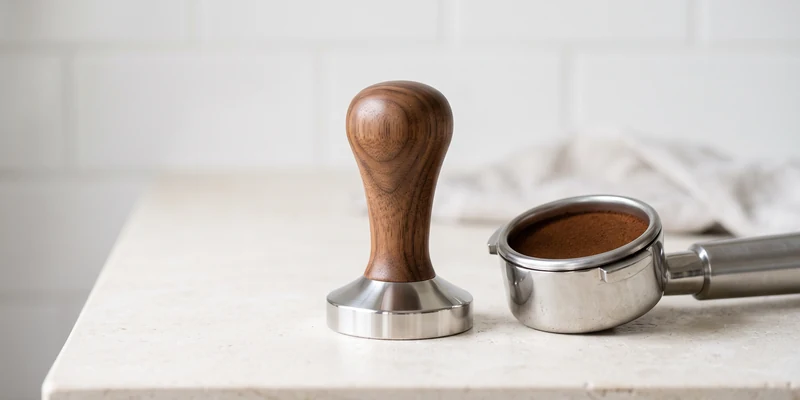
A plain stainless steel flat-base tamper in 58mm with a wooden handle. No spring, no calibration, just a polished face and a comfortable grip. If your technique is steady, this does everything a costlier tamper does.

☕ Best for Breville Machines
Sized around 53.3mm for the 54mm portafilters Breville uses at home, so it reaches the basket wall instead of leaving a ring of loose grounds. The obvious upgrade over the lightweight tamper in the box.

One More Piece: Where You Tamp Matters
A tamper is only half the setup. Pressing down on a bare countertop puts the whole load on the portafilter spouts and on your stone or laminate, and it lets the portafilter slide at exactly the moment you want it still. A silicone tamping mat solves both problems cheaply, which is why it belongs in this guide rather than a footnote.
🧰 Also Great
A silicone tamping mat, either a flat pad or an angled corner shape that hangs over the counter edge. It grips the portafilter, absorbs the pressure, protects the surface, and wipes clean under the tap. Heat resistant silicone also takes a hot portafilter without a second thought.

How to Tamp Consistently (Force Is Not the Point)
Consistency beats strength every time. The goal is a level, evenly compressed bed of coffee, not the maximum force your arm can produce. Once the grounds are compressed, pressing harder changes very little about the extraction and a lot about your wrist over a few years of daily shots. Aim for the same pressure, repeated the same way, at the same speed.
A repeatable routine
Level the grounds first, with a distribution tool or by settling the basket gently. Set the tamper flat on the bed and check that the handle is vertical, not leaning. Press down in one smooth motion with your elbow above your wrist, hold for a beat, then lift straight up without twisting or knocking the basket. That last part matters: a knock after tamping cracks the edge of the puck and gives water somewhere to escape.
Judge the result, not the effort
The feedback loop lives in the cup and in the shot timer, not in how hard you pushed. If shots run fast and taste thin, adjust the grind finer before you consider tamping harder. Pairing the tamper with a scale makes this readable, because you hold the dose steady while you change one thing at a time. Our roundup of the best coffee scales covers the models with the resolution espresso needs.
Common Mistakes to Avoid
- Buying by machine size instead of basket size. A 54mm portafilter does not take a 54mm tamper. Measure the basket and buy to that number.
- Trusting the number on the box. Tolerances vary between makers and baskets. If a tamper arrives with a visible gap or refuses to seat, it is the wrong size, not a flaw in your technique.
- Chasing force instead of repeatability. Pressing harder does not extract more. Pressing the same way every time is what makes grind adjustments meaningful.
- Twisting or knocking after the tamp. Both disturb the edge of the puck, where channeling starts. Lift straight up and leave the basket alone.
- Skipping the mat. Tamping on bare stone stresses the portafilter, marks the counter, and lets it slide mid press.
Where to Go From Here
Grind quality sets the ceiling for everything else, so if you are still on a blade grinder or a basic burr unit, our guide to the best manual coffee grinders explains what changes when the particles get consistent. If you are shopping the machine itself, the roundup of the best manual lever espresso machines covers the hands-on end of the market where a good tamper matters most, and the semi-automatic guide covers the pump machines most people land on.
Frequently Asked Questions
What size espresso tamper do I need? Measure the inside diameter of your basket and buy a tamper a fraction smaller. Machines with a 58mm group usually take a base in the 58.0mm to 58.5mm range, and Breville home machines with a 54mm portafilter take one around 53.3mm.
Why does my Breville machine need a 53.3mm tamper? The 54mm figure describes the portafilter, not the basket inside it. The basket is narrower, so a base around 53.3mm is what actually reaches the wall.
Is a calibrated tamper worth it? It is, if consistency is your weak point, which it is for most people learning espresso. The spring stops you at the same point every time, so when a shot changes you know it was the grind or the dose.
Flat or convex base? Flat is the sensible default and makes it easy to see whether your puck is level. Convex is worth trying if you keep seeing channeling at the edge, but many people notice no difference.
How hard should I press? Hard enough to compact the bed, then stop. There is no magic figure, and consistent pressure repeated the same way matters far more than a heavy press. Save your wrists and adjust the grind instead.
Do I need a tamping mat? Not strictly, but it protects your counter, stops the portafilter sliding, and takes the load off the spouts. It is the cheapest upgrade here and it makes the routine feel steadier.
The Bottom Line
Get the diameter right and most of this decision is made: measure your own basket, buy a base that seats cleanly, and ignore the number printed on your machine. From there, a calibrated tamper buys repeatability, a classic stainless one does the same job if your technique is steady, and a silicone mat protects your counter and portafilter. Consistency, not force, is what turns a good grinder into good espresso.