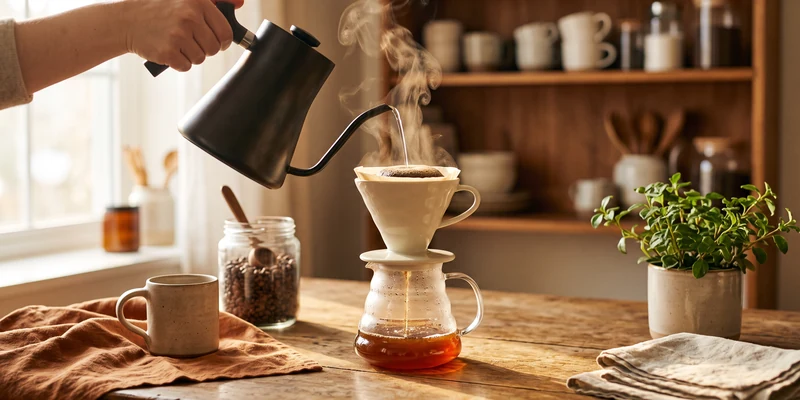
Last updated: August 13, 2026
Choosing a pour over coffee maker looks like a small decision and turns into a rabbit hole. One shop sells a cone with a single hole, another a flat bottom with three, a third a glass hourglass that has been on kitchen counters since the 1940s. All promise a cleaner, sweeter cup, and the confusing part is that they are all telling the truth. They simply suit different people and different mornings.
This guide sorts the category the way a buyer actually decides: one cup or a full carafe, forgiving or precise, paper or metal. Underneath those three questions sit four brewing variables that matter more than the name on the dripper.
This article contains affiliate links. If you buy through them, we may earn a commission at no extra cost to you. Learn more.
Quick Answer
Which pour over coffee maker should you buy?
- Brewing one or two cups and happy to learn the pour: a cone dripper like the Hario V60 gives you the most control over how the cup turns out.
- New to pour over, or you want the same result every morning without thinking: a flat bottom dripper like the Kalita Wave is far more forgiving of an uneven pour.
- Serving three or more people at once: a Chemex brews and serves from one vessel, and its thick paper filters make the clearest cup in this guide.
Cone or Flat Bottom: The Choice That Decides Everything Else
The shape of the brewing chamber is the most important spec, because it decides how much your technique affects the cup. A cone funnels water toward one large opening, so your kettle sets the pace. A flat bottom holds the coffee in an even bed above two or three small holes, so the water pools slightly and extracts more uniformly whether or not your pour is tidy.
| What to check | Why it matters | What to look for |
|---|---|---|
| Brewer shape | Sets how much your pour affects the cup | Cone (V60, Chemex) for control; flat bottom (Kalita Wave, most OXO brewers) for consistency |
| Drainage | Controls water and coffee contact time | One large hole gives you the pace; two or three small holes set a steadier pace for you |
| Capacity | Filter size and dripper size are linked | Size 01 for one cup, size 02 for one to three, a 6-cup or 8-cup Chemex for a table |
| Material | Affects heat, weight, and durability | Ceramic and glass hold heat well once rinsed; plastic and stainless survive drops and travel |
| Filter type | The biggest influence on body and clarity | Paper for a clean cup, metal mesh for more body and sediment, cloth for something between |
| Filter availability | Proprietary shapes run out easily | V60 cones and Chemex circles are widely stocked; buy Wave filters with the brewer |
| Serving vessel | Some brewers need a carafe, some are one | A dripper needs a mug or server underneath; a Chemex is both, which saves washing up |
Simplest tiebreaker: if pour over is a daily ritual you enjoy, buy the cone. If it has to work at 6 a.m. before you are properly awake, buy the flat bottom.
One Cup or a Full Carafe?
Match the brewer to the number of cups you make most often, not the number you make on your best weekend. Pour over has a hard ceiling: past a certain volume the bed gets too deep, the water takes too long to pass through, and the end of the cup tastes flat.
Single cup and small batch
For one or two mugs, a size 01 or 02 cone on your mug or a small server is the whole setup. It heats quickly, uses a modest dose, and rinses in seconds. A small bed of freshly ground beans is the easiest thing in coffee to brew well.
Three cups and up
Once you are serving other people, the Chemex earns its reputation. It brews and serves from one piece of glass, so nothing cools during a transfer, and the thick bonded filters produce a strikingly clear cup. The trade-off is honest: those filters slow the brew, and the narrow neck takes more effort to clean. If you regularly need eight or ten cups, a machine is the more realistic tool, and our guide to the best drip coffee makers covers the ones that get closest to a pour over result.
Paper or Metal: What the Filter Actually Changes
The filter changes the cup more than the dripper does. Paper traps most of the coffee oils and nearly all of the fine particles, which is why paper filtered coffee tastes clean, bright, and tea like. Metal mesh lets those oils and some sediment through, giving a heavier, rounder cup. Neither is better; they are different drinks from the same beans.
When paper is the right call
Choose paper if you like clarity and want the delicate flavors in a lighter roast to come forward. Rinse the filter with hot water first, to wash away papery taste and preheat the brewer. Chemex filters are noticeably thicker than V60 or Wave filters, which is why a Chemex cup reads as the cleanest here.
When metal is the right call
Choose metal if you like body, hate running out of filters, or want to throw less away. Expect a cloudier cup, a little sediment, and a grind that matters more, since fine particles pass straight through mesh. If cutting down on disposables and plastic is part of the appeal, our roundup of plastic-free coffee makers goes deeper on materials.
Our Top Picks at a Glance
How we chose: we compared the pour over brewers widely available in the United States on shape and drainage, filter availability, heat behavior, and capacity. Selections lean on manufacturer specifications and recurring patterns in owner reviews rather than any hands-on trial of our own. Every pick below is a complete brewer, not a starter kit.
🏆 Best Overall
The cone that defined modern pour over: spiral ribs, a single large opening, and enough control that changing your pour changes the cup. Ceramic holds heat well once rinsed, and the filters are stocked almost everywhere.

🎯 Best for Beginners
A flat bottom brewer with three small holes and a wavy filter that keeps the coffee bed even. Because the water pools slightly before it drains, a sloppy pour costs you far less than it would in a cone. Stainless steel survives being knocked around.

🫖 Best for a Full Carafe
Brewer and server in one piece of glass, with thick bonded filters that produce the clearest cup in this guide. Ideal when coffee is something you serve rather than drink standing at the counter. Reviews consistently mention it looks as good empty as full.

Picks by Situation: Budget, Paperless, and the Upgrade
The three above cover most buyers. These three cover the reasons people keep looking: spending as little as possible, never buying filters again, or wanting the nicer details.
💰 Best Budget Pick
The same cone geometry as the ceramic original in a lightweight plastic body. It costs less, it will not crack in the sink, and it comes up to temperature almost instantly. The least expensive honest way in.

♻️ Best Paperless
A fine stainless mesh cone that sits on a mug or carafe and never needs a filter again. Expect a fuller, cloudier cup with a little sediment, which is exactly what some people are after. Grind a touch coarser than you would for paper.

⭐ Upgrade Pick
A precision minded set for people who already like the ritual: a machined dripper, a matched carafe, and build quality that makes the morning feel deliberate. Worth it if you brew daily and enjoy the equipment as much as the coffee.
![Fellow Stagg [XF] Plastic Free Pour-Over Coffee Maker Set, 1-2 Se...](https://m.media-amazon.com/images/I/31MdkC7H0IL._AC_.jpg)
The Two Accessories That Change More Than the Brewer
Be honest about where the money goes: a grinder and a kettle will improve your pour over more than swapping one dripper for another. Pour over is unforgiving of uneven grounds, because water finds the easiest path through the bed, and unforgiving of an uncontrolled pour.
A burr grinder first
Blade grinders chop beans into powder and chunks. The powder over extracts and clogs the filter while the chunks barely give anything up, so the cup tastes bitter and thin at once. A burr grinder cuts to a set size instead, and hand grinders are good value at the small doses pour over uses. See the best manual coffee grinders, and the French press grinder guide for why the coarse end of the dial is where cheap grinders struggle.
A gooseneck kettle second
A gooseneck spout lets you place water where you want it, at the pace you want, which is the entire skill of pour over. Variable temperature models let you dial into the commonly recommended range. Start with the best gooseneck kettles for pour over, or the Cosori gooseneck kettle review. A coffee scale is the cheap third piece.
Pour Over Basics: Grind, Ratio, Temperature, Bloom
Four variables cover almost everything. Get them roughly right and any brewer here makes good coffee. Treat the numbers below as widely used starting points, and change one thing at a time.
Grind and ratio
For pour over, a medium to medium-fine grind is commonly recommended, often compared to table salt. Chemex suits the coarser end because its thick filters slow drainage, while a V60 cone likes something finer. On ratio, many people start around 1:15 to 1:17, meaning one gram of coffee to fifteen or seventeen grams of water. Move toward 1:15 for a stronger cup, 1:17 for a lighter one.
Temperature and bloom
Water in the commonly recommended range of about 195 to 205 F (roughly 91 to 96 C) suits most coffees, and boiling then waiting 30 to 45 seconds lands you close enough. Then bloom: pour about two to three times the coffee weight over the dry grounds and wait 30 to 45 seconds. Fresh beans release carbon dioxide when they meet water, and that gas pushes water away from the grounds and causes uneven extraction. Fresh coffee visibly swells during the bloom while older coffee barely reacts, so it doubles as a freshness check.
Common Mistakes to Avoid
- Using pre-ground supermarket coffee. It is usually ground for a drip machine and stales quickly. Whole beans and a burr grinder change the cup more than any brewer swap.
- Skipping the filter rinse. Thirty seconds of hot water removes papery taste and preheats the brewer.
- Pouring straight from a rolling boil. That sits above the commonly recommended range and tends to scorch lighter roasts. Wait half a minute.
- Dumping all the water in at once. A fast single pour channels through the bed and leaves half the coffee under extracted. Pour in stages, bed level.
Where to Go From Here
If pour over is more ritual than you want on a weekday, immersion brewing is the easier neighbor: the coffee sits in the water and time does the work. Start with how to use a French press, then moka pot versus French press for two takes on a stronger cup. For a brewer that travels and cleans up in seconds, see the AeroPress buying guide. When the weather turns, the best cold brew coffee makers guide explains concentrate versus ready to drink.
Frequently Asked Questions
Is pour over coffee actually better than drip? It is more controllable, which is not the same thing. You choose the water temperature, the pace, and how the bed is wetted, so a careful pour over can beat an average machine. A well built drip brewer that holds temperature gets very close with none of the effort.
What grind size do I need for pour over? A medium to medium-fine grind is commonly recommended, often compared to table salt. Go slightly coarser for a Chemex and finer for a cone. If the drawdown drags, coarsen it; if the water rushes through, tighten it.
Do I really need a gooseneck kettle? Not to start, but it is the accessory people upgrade to first. A narrow spout puts water where you aim it instead of dumping it in one spot, which is most of the technique. Our gooseneck kettle guide covers the options.
What is the bloom and can I skip it? The bloom is a small first pour, usually two to three times the coffee weight, that lets fresh grounds release carbon dioxide before the main pour. You can skip it, but that trapped gas pushes water away from the coffee and gives a less even extraction.
The Bottom Line
The right pour over coffee maker follows from three answers: how many cups you brew at once, how much you want your technique to matter, and whether you prefer a clean paper filtered cup or a fuller one through metal. A V60 rewards involvement, a Kalita Wave forgives a rushed morning, and a Chemex serves a table from one piece of glass. Whichever you choose, spend on a burr grinder before a second brewer.