Last updated: August 13, 2026
Learning how to use a French press coffee maker takes about four minutes, and almost everyone gets it slightly wrong at first. The device could not be simpler: coffee in, hot water in, wait, push the plunger down. Yet the same press that produces a rich, rounded cup in one kitchen produces a gritty, bitter one in another, using the same beans.
The difference is never the press. It is the grind, the ratio, the water temperature, and what you do in the thirty seconds after you push the plunger. Below is the full method with a reason attached to every step, so you can adjust it instead of memorizing it.
Quick Answer
How do you use a French press?
- Grind coarse, roughly the texture of coarse sea salt, and use a ratio somewhere around 1:15, so about 60 grams of coffee per liter of water.
- Use water in the commonly recommended range of about 195 to 205 F (roughly 91 to 96 C), bloom for 30 to 45 seconds, then steep about four minutes.
- Plunge slowly and pour the coffee out straight away, because anything left sitting on the grounds keeps extracting and turns bitter.
The Method, Step by Step
Eight steps, start to finish, in about five minutes including the kettle. Every instruction has a reason attached, because once you know why a step exists you can adapt it to your beans instead of following it blindly.
- Preheat the press. Fill it with hot water, swirl, and pour it out. Cold glass pulls heat straight out of your brew, and temperature loss in the first minute is the most common invisible reason a press tastes weak.
- Weigh and grind coarse. Aim for a texture commonly compared to coarse sea salt. The metal mesh only holds back larger particles, so anything finer passes through and settles as silt in the bottom of your cup.
- Set your ratio. A range of about 1:12 to 1:17 covers most tastes, and many people start around 1:15. Weigh the coffee if you can; volume scoops vary wildly with roast level and grind size.
- Heat the water. The commonly recommended range is about 195 to 205 F (roughly 91 to 96 C). Without a variable temperature kettle, boil and then wait 30 to 45 seconds, which lands you close enough.
- Bloom the grounds. Pour about two to three times the coffee weight in water over the dry bed and wait 30 to 45 seconds. Fresh beans release carbon dioxide when they meet water, and that gas pushes water away from the grounds and causes uneven extraction.
- Pour the rest and stir the crust. Add the remaining water, then gently break the floating layer of grounds with a spoon so everything is properly wet. Dry pockets contribute nothing but volume.
- Steep about four minutes. Put the lid on with the plunger resting at the top, not pushed down. The lid keeps the heat in; the plunger stays up so the coffee can circulate.
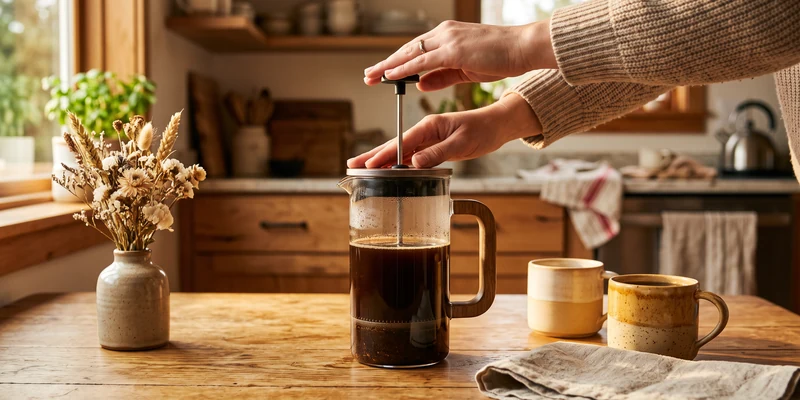
- Plunge slowly, then decant immediately. Push down with steady, even pressure over about 20 seconds. Then pour every last drop into cups or a separate carafe.
That last step is the one people skip, and it matters most. Coffee left sitting on the grounds keeps extracting long after you have plunged, which is why the second cup from a press so often tastes harsh when the first was fine.
How Much Coffee for Your Press Size
Work from the water your press actually holds, not the size printed on the box. Most presses are labeled by total volume, and you fill to just below the bottom of the plunger assembly, so usable capacity runs a little lower. The table below uses a 1:15 ratio as a starting point.
| Press size | Coffee (grams) | Water (grams) | Ratio |
|---|---|---|---|
| 12 oz (350 ml) | 22 g | 330 g | 1:15 |
| 34 oz (1 liter) | 63 g | 950 g | 1:15 |
| 51 oz (1.5 liter) | 93 g | 1400 g | 1:15 |
Treat these as rules of thumb. If the result tastes thin, move toward 1:13 or 1:14; if it tastes heavy or harsh, move toward 1:16 or 1:17. Grams and milliliters of water are close enough to interchangeable here, which is why a coffee scale makes this method repeatable.
Why a French Press Tastes the Way It Does
A French press is an immersion brewer: the coffee sits in the water for the whole brew, and time does the work. A pour over is a percolation brewer, where fresh water passes through the bed once and leaves. That single difference explains most of what people like and dislike about press coffee.
Immersion is forgiving
Because everything soaks together, the press is far less sensitive to how you pour than a cone dripper is. There is no technique to master and no channeling to worry about. The trade-off is less control: once the water is in, your only lever is time. Our guide to the best pour over coffee makers covers the opposite approach, where every second of the pour matters.
The metal filter is the point
Paper filters trap coffee oils and nearly all fine particles. The press uses a metal mesh instead, which lets those oils and some fine sediment through. That is precisely where the heavy, rounded texture comes from, and it is why press coffee tastes fuller and less crisp than the same beans through paper. If you want a stronger, more concentrated style instead, moka pot versus French press lays out how the two compare.
Getting the Grind Right
Grind is the biggest variable in press coffee, and where most muddy cups begin. Coarse grounds are held back by the mesh; fine ones are not. Those fine particles, known as fines, cause three problems at once: a cloudy, gritty cup, a plunger that feels heavy going down, and over extraction that keeps building after you plunge.
Blade grinders make fines unavoidable, because they smash beans into a mix of powder and chunks rather than cutting them to a size. A burr grinder does the opposite, which is why upgrading the grinder changes press coffee more than upgrading the press ever will. See what to look for in our guide to the best grinders for French press, or the manual coffee grinder guide if a hand grinder suits your counter. Two practical notes: a press dose is large, so hand grinding a full liter takes real effort, and many budget grinders are least consistent at exactly the coarse settings a press needs.
Cleaning the Press Properly
Rinse the carafe right after decanting, while the grounds still slide out easily. A rubber spatula moves them into the bin or compost without clogging your sink.
Once a week, unscrew the plunger assembly completely. It comes apart into three or four pieces: the rod with its disc, the mesh screen, and one or two supporting plates. Old coffee oils collect in the threads and around the screen edge, and they carry a stale note into everything you brew afterward. Wash the parts with dish soap, dry them, and screw the stack back together snugly so the mesh sits flat against the glass.
Common Mistakes to Avoid
- Using pre-ground supermarket coffee. It is almost always ground for a drip machine, which is far too fine for a press. That grind alone accounts for most gritty, bitter cups.
- Pouring straight from a rolling boil. Water at a full boil sits above the commonly recommended range and tends to scorch lighter roasts. Wait 30 to 45 seconds after the kettle clicks off.
- Forcing the plunger down. If it resists, your grind is too fine. Pushing harder squirts grounds up around the edge of the screen and straight into the coffee.
- Leaving the coffee in the press. Whatever stays behind keeps extracting on the grounds. Decant everything into cups or a carafe the moment you plunge.
- Never taking the filter apart. A screen that has never been unscrewed is holding weeks of old oils. It is a five minute job that noticeably cleans up the taste.
Where to Go From Here
If your press coffee is already good and you want it consistent, two small tools do the most work. A scale turns a vague scoop into a repeatable recipe, and a narrow spout gives you control over the bloom. See the best coffee scales and the best gooseneck kettles for both.
Frequently Asked Questions
How long should you steep French press coffee? About four minutes is the most commonly recommended starting point. Shorter tends toward a lighter, brighter cup and longer toward a heavier one, so adjust in 30 second steps rather than jumping to eight minutes.
How much coffee do I use per cup? Many people start around 1:15 by weight, which works out to roughly 60 grams of coffee per liter of water. Weighing it once gives you a recipe you can repeat instead of a guess that changes with every bag.
Why is my French press coffee muddy? Almost always the grind. Fine particles slip through the metal mesh and settle in the cup, and a blade grinder produces them no matter how careful you are. A burr grinder set coarse fixes it; see the grinder guide.
Can I leave the coffee in the press after plunging? Better not to. The grounds stay in contact with the liquid and keep extracting, which is why a press that tasted good at four minutes tastes harsh twenty minutes later. Decant it all at once.
The Bottom Line
Using a French press well comes down to four things: a coarse, even grind, a ratio somewhere around 1:15, water in the commonly recommended 195 to 205 F range, and pouring the coffee out the moment you plunge. Everything else is refinement. If your cup is muddy or bitter, look at the grinder before you look at the press.