Last updated: July 22, 2026
Looking for a no plastic coffee maker usually comes down to one specific question rather than a general preference: what does the water actually touch on its way from the tank to the cup? A machine can have a beautiful brushed steel shell and still run every drop through a plastic reservoir, a plastic tube, a plastic shower head, and a plastic brew basket. The outside tells you almost nothing about the water path.
This guide takes the water path apart stage by stage, shows you where plastic sits in a typical machine, explains how to audit a brewer you already own, and points to the setups that keep the whole path in stainless steel, glass, or ceramic. Some people prefer to limit plastic in the parts that hold hot water, and this is the practical version of that shopping list. We describe materials and what manufacturers state about them, and we leave conclusions beyond materials to you.
This article contains affiliate links. If you buy through them, we may earn a commission at no extra cost to you. Learn more.
Quick Answer
Which coffee makers keep plastic out of the water path?
- Stovetop brewers win outright. A stainless percolator or a stainless moka pot runs water through metal from start to finish, with a gasket as the only exception.
- A stainless gooseneck kettle poured over a glass or ceramic brewer is the cleanest manual path, and it gives you temperature control as a bonus.
- Among plug-in machines, an electric percolator with a stainless interior keeps the brewing chamber in metal; standard drip machines almost always use a plastic reservoir and brew basket.
The Water Path, Stage by Stage
Every coffee maker moves water through the same sequence, whether it is a stovetop pot or an automatic drip machine. Walking that sequence is the fastest way to judge a product, because it turns a vague question about materials into six specific checks. Here is where each stage usually lands in a typical electric brewer, and what a metal or glass alternative looks like.
| Stage | Usually made of | Metal or glass alternative |
|---|---|---|
| Reservoir | Plastic tank, molded into the housing on most drip machines | Stainless pot on a stovetop brewer, or a glass or steel kettle you fill yourself |
| Heating element | Aluminum or copper tube, metal on nearly all machines | Already metal, though some brands market copper specifically |
| Riser or delivery tube | Silicone or plastic tubing from element to shower head | Steel percolator stem, or the internal channel of a moka pot |
| Shower head or spreader | Plastic dispersion disc on most drip machines | Metal spreader plate, or your own pour from a kettle |
| Brew chamber or basket | Plastic basket, even on machines with metal bodies | Stainless basket, ceramic dripper, or glass brewing cone |
| Carafe | Glass or stainless, with a plastic lid on many models | Glass carafe or a fully stainless thermal carafe with a metal lid |
Read that table once and most product listings become easy to evaluate. The two stages that decide almost every case are the reservoir and the brew basket, because those are the parts manufacturers mold rather than fabricate.
Why the Reservoir Is the Hardest Part to Change
Water tanks are molded plastic for engineering reasons rather than cost-cutting alone. A tank needs to be shaped around the machine’s internals, sealed against leaks, transparent enough to show a fill level, and light enough to lift and refill. Molded polymer does all four at once. Glass would need a separate housing and would be fragile in a removable tank, and stainless would hide the water level and add weight.
That is why the machines with genuinely metal water paths are the ones with no separate tank at all. A stovetop percolator is its own reservoir: you fill the steel pot, the water heats in the steel pot, it rises through a steel stem, and it falls back through a steel basket. A moka pot does the same thing under pressure. Neither has a component that needs to be molded, which is exactly why neither has one.
How to Audit a Machine You Already Own
Before replacing anything, spend five minutes checking what you have. Lift out the brew basket and look at it in daylight rather than on the product page, since black resin and dark-coated metal look identical in photos. Open the lid and look at the spreader above the basket. Pull the tank if it is removable, and check whether the fill opening leads into a molded well or into a metal chamber.
Then check the carafe lid, which is the most commonly overlooked part on thermal models. If everything except the basket is metal or glass, a stainless replacement basket sometimes exists for popular machines, and a permanent stainless mesh filter can replace a plastic-framed reusable filter. If the tank and the spreader are plastic, the machine is what it is, and the honest path forward is a different brewing method rather than an accessory.
Our Top Picks at a Glance
How we chose: we traced the water path of widely available brewers from reservoir to cup and favored designs where every stage is stainless steel, glass, or ceramic, with seals as the only exception. Selections lean on manufacturer material specifications and recurring themes in owner feedback rather than any hands-on trial of our own.
One reassurance before the list: none of these are compromise brewers. Percolators, moka pots, and pour over setups are established methods with large followings, not workarounds.
🏆 Best All-Metal Water Path
A stovetop stainless percolator is the cleanest answer in the whole category: water sits in a steel pot, rises through a steel stem, passes through a steel basket, and returns to the same steel pot. No tank, no tubing, no spreader, and no filter required. It also works on a campfire or a gas burner during an outage. Our percolator guide covers grind and timing, which is where percolators are won or lost.

🔌 Best Electric With a Metal Brewing Chamber
If you want a machine that switches itself off but still keeps the water in metal, an electric percolator with a stainless interior is the practical option. The brewing chamber, stem, and basket are steel; the base, handle, and lid knob are resin, which is the standard construction and worth confirming per model before you order.

🔥 Best for Concentrated Coffee
A stainless moka pot pushes water from a steel lower chamber through a steel funnel and basket into a steel upper chamber, with a rubber or silicone gasket at the seal and resin only on the handle and knob. Stainless models also work on induction, which classic aluminum ones do not. See the field in our stainless moka pot roundup.

Picks by Situation: Pour Over, Immersion, and the Drip Compromise
The three above cover the fully metal end. These three cover the setups people actually build when they want control, a full carafe, or a machine that starts on a timer.
🫖 Best Manual Path You Control
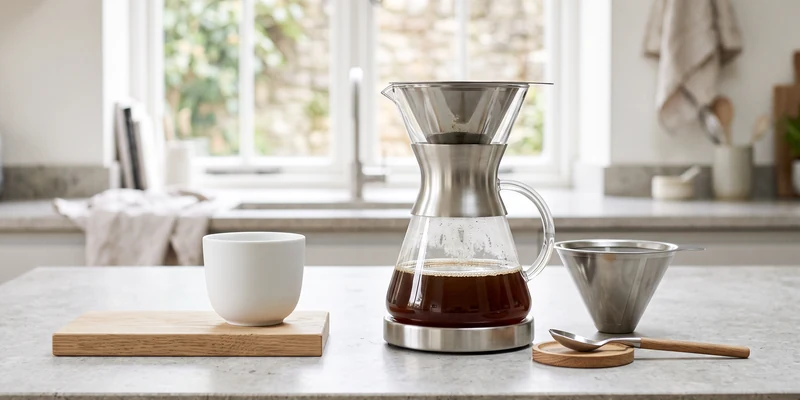
A stainless gooseneck kettle poured over a glass brewer gives you a path of steel, glass, and paper with nothing else in between. It also hands you temperature control, which no percolator offers. Check the kettle carefully, since lids, sight windows, and spout collars are common plastic spots even on steel kettles. Our gooseneck kettle guide flags which models keep the interior all metal.

☕ Best Immersion Brewer
A double-wall stainless French press holds water in steel and filters through steel mesh, so the only questions are the lid and the seal ring around the filter, which is usually a food-grade polymer even on all-steel presses. It keeps coffee hot far longer than a glass beaker and survives a drop. Grind and timing are covered in our French press walkthrough.

⚡ Best Automatic Drip Compromise
Nobody sells an automatic drip machine with a fully metal water path, so this is the honest middle ground: a metal housing, a copper heating element, and a glass carafe, with the brew basket and some reservoir components still plastic, which the manufacturer states are BPA-free. Far less plastic than a typical drip brewer, but not none. Compare with the wider field in our drip coffee maker guide.

Filters, Seals, and the Two Parts Everyone Forgets
Two components sit inside the water path and get skipped in almost every buying decision. The first is the filter. Paper is paper, so no issue there, but reusable filters are frequently stainless mesh mounted in a molded frame, which puts plastic directly in the brew stream. Fully stainless mesh baskets and cloth filters both avoid it, and percolators often need no filter at all.
The second is the gasket. Moka pots, pressure brewers, and most presses need a seal, and seals are rubber or silicone rather than steel. This is not something you can design away, so treat it as the one exception rather than a dealbreaker. Moka pot gaskets are consumable parts that should be replaced when they harden or crack, which is also good practice for brewing quality; a tired gasket leaks steam and weakens the brew.
Keeping a Metal Water Path Clean
Metal brewers have one weakness: you cannot see inside them. Coffee oils build up on steel over time and turn stale, and mineral scale accumulates in anything that heats water. Neither shows up until the coffee tastes flat, so a schedule beats inspection here. Rinse and dry after each use rather than leaving pots wet, and run a deep clean with a dedicated coffee equipment cleaner periodically.
Descaling matters most on electric percolators and kettles, where a heating element sits in the water. Follow the manufacturer’s instructions for the machine you own, and note that acidic descalers appropriate for one material are not always appropriate for another. Our guide to descaling solutions for coffee machines sorts that out, and our walkthrough on cleaning a coffee maker with vinegar covers the household approach and its limits.
Common Mistakes to Avoid
- Judging by the housing. A stainless exterior says nothing about the tank, the tube, or the basket. The water path is inside.
- Buying a reusable filter in a plastic frame. It sits directly in the brew stream. Look for an all-stainless mesh basket or use paper.
- Forgetting the carafe lid. Thermal carafes are steel outside and frequently have a molded lid and pour mechanism, which the coffee passes through on the way out.
- Expecting a plastic-free automatic drip machine. They are not really sold. If a timer and a full carafe are non-negotiable, accept the compromise knowingly.
- Ignoring an old gasket. On moka pots and pressure brewers, a hardened seal leaks and weakens the brew. Replace it as a routine consumable.
Where to Go From Here
If you care about the materials of the whole product rather than only the water path, our companion guide to plastic-free coffee makers covers glass, ceramic, wood, and steel brewers across every method, including the parts that hide resin. If the pour over route appeals, the pour over coffee maker guide compares glass, ceramic, and metal drippers side by side. And if you brew cold rather than hot, the same logic applies to glass and stainless vessels in our cold brew maker roundup.
Frequently Asked Questions
Which coffee makers have no plastic in the water path? Stovetop stainless percolators and stainless moka pots come closest, since water only touches steel and a seal. A stainless kettle poured over a glass or ceramic brewer is the manual equivalent.
Do any drip coffee makers have a stainless water tank? Very few, if any, in the consumer market. Reservoirs are molded because they need to be shaped, sealed, transparent, and light. Machines with metal water paths generally have no separate tank at all.
Is the heating element itself plastic? No. Heating elements and their tubes are metal on essentially every machine, commonly aluminum or copper. The plastic in a drip machine is concentrated in the reservoir, the delivery tubing, the spreader, and the basket.
Can I replace a plastic brew basket with a metal one? Sometimes, for popular machines, and a permanent stainless mesh filter is often available too. If the reservoir and spreader are plastic as well, changing the basket alone will not accomplish much.
Does a moka pot count as plastic-free? The entire water path is metal, and only the handle, knob, and gasket are not. If a silicone or rubber seal is acceptable to you, a moka pot qualifies; if not, a percolator with a metal-to-metal fit is the closer option.
The Bottom Line
Keeping plastic out of the water path means choosing a brewer that has no molded tank: a stainless stovetop percolator, a stainless moka pot, or a steel kettle poured over glass or ceramic. Electric percolators with stainless interiors are the practical plug-in option, and even the best drip machines keep plastic in the reservoir and basket. Audit the six stages from tank to carafe and any listing becomes easy to judge.