Last updated: July 22, 2026
If your morning pot brews slower than it used to or tastes flat in a way fresh beans cannot fix, the machine is usually the culprit. The standard home remedy is to clean a coffee maker with white vinegar, and on a basic drip machine that is often all it takes: vinegar is acidic enough to dissolve the mineral scale that heated water leaves behind, and it is already in your kitchen.
The catch is that vinegar is not universal. Several manufacturers tell owners not to use it, some machines have parts that do not appreciate acetic acid, and the smell outstays its welcome if you rush the rinsing. Here is the method, plus the cases where a purpose made descaler is the smarter call.
Quick Answer
How do you clean a coffee maker with white vinegar?
- Fill the reservoir with vinegar and water at the ratio your manual gives, run half a brew cycle, let it sit, then finish the cycle.
- Follow with several full cycles of clean water until no vinegar smell remains, and wash the carafe and filter basket separately.
- Skip vinegar if your manual says so, or on espresso machines, pod machines, and anything with aluminum in the water path.
How to Clean a Drip Coffee Maker With Vinegar, Step by Step
This routine is for a standard drip coffee maker with an open reservoir and a glass or thermal carafe. Read your manual first: if it names a ratio, a product, or rules vinegar out, the manual wins over any advice online, including ours. Nothing here involves opening the machine.
- Unplug the machine and let it cool. Empty the carafe, discard old grounds, and remove the paper filter.
- Check the manual for the ratio. Many manuals describe roughly equal parts white vinegar and water, some brands call for a weaker mix, and others rule it out. Use plain distilled white vinegar, and never mix it with another product.
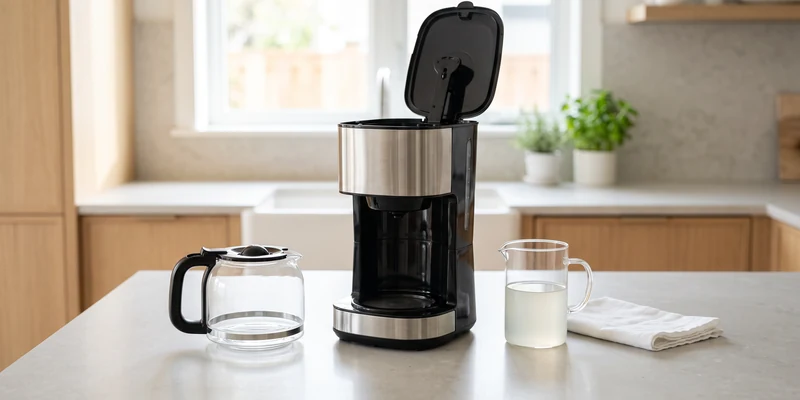
- Fill the reservoir. Mix the solution in the carafe first, then pour it in to your normal brewing level. Put the carafe back and insert a clean paper filter if your machine uses one, to catch loosened debris.
- Run about half a cycle, then stop. Switching off midway leaves warm solution in the tubing and around the heating element, where most of the scale lives.
- Let it sit. Thirty minutes to an hour with the machine off. Heavily scaled machines benefit from the longer end, but there is little point leaving it overnight.
- Switch it back on and finish the cycle. Let the rest brew through, then pour the used solution down the drain.
- Rinse with several cycles of clean water. This is the step people cut short. Fill with fresh water, run a full cycle, discard, repeat. Most machines need at least three, and the finish line is simple: keep going until you cannot smell vinegar.
- Wash the carafe, lid, and filter basket by hand. Coffee oils collect here, and solution running through the machine does not scrub them. Warm water, dish soap, and a soft brush.
- Wipe the outside and the hot plate. A damp cloth on the housing, the cold warming plate, and the shower head area. Leave the reservoir lid open to dry.
If the coffee still tastes faintly sharp the next morning, run another water cycle before brewing.
Why Scale Builds Up and What It Does to Your Brew
Scale is mineral deposit, mostly calcium and magnesium carbonate, left behind when hard water is heated. Your coffee maker boils water every day, so minerals concentrate on the hottest surfaces first: the heating element, the tube carrying water to the shower head, and the shower head openings.
Two effects are noticeable. Flow slows down, because a partly blocked tube takes longer to push the same volume through, which is why a scaled machine gurgles more and sometimes stops short of a full pot. Less obviously, a mineral layer sits between the element and the water like an insulating blanket, so water reaching the grounds can run cooler than intended. Brewing below the intended temperature tends to underextract, and that reads as sour, thin, or simply weak.
When Vinegar Is the Wrong Choice
Vinegar is a blunt instrument: acetic acid in a machine designed around a specific product. Four cases make it the wrong call.
Your manufacturer says not to. Several brands, including Breville and Keurig, direct owners to their own descaling solution and discourage vinegar. That is also the line the warranty is written against. For Breville machines, our walkthrough of how to descale a Breville espresso machine covers the specified process.
There is aluminum or a sensitive seal in the water path. Acetic acid is not kind to bare aluminum, and stovetop moka pots, some older percolators, and certain internal parts qualify. Rubber and silicone seals also age faster under repeated acid exposure. For stovetop brewers, our percolator guide applies: hot water, a soft brush, and patience.
You own an espresso or pod machine with a closed water path. These have pumps, boilers or thermoblocks, valves, and narrow lines you cannot see or flush by eye. A drip brewer is essentially a straight pipe; an espresso machine is a plumbing diagram. Manufacturers publish descaling cycles for a reason, and the specified solution is part of the cycle. Our Keurig troubleshooting guide starts there.
You cannot tolerate the smell. Vinegar clings to plastic reservoirs and thermal carafe interiors, and the first pot after a rushed rinse tastes unmistakably of it.
Vinegar vs Commercial Descaler: How They Compare
Neither is universally better. Vinegar wins on availability and cost, descaler wins on speed, smell, and material compatibility.
| Factor | White vinegar | Commercial descaler |
|---|---|---|
| Cost | Pantry staple, the cheapest route | A modest ongoing purchase |
| Odor | Strong and persistent in plastic parts | Most formulas are close to odorless |
| Rinse time | Three or more full water cycles | Usually one or two, per the label |
| Warranty position | Discouraged by several makers | The approved route, and some brands require their own |
| Espresso and pod machines | Not recommended, closed water path | The intended method, follow the descale cycle |
| Aluminum parts | Avoid, acid can attack bare aluminum | Check the label for stated compatibility |
If the table pushes you toward the formulated route, our roundup of the best descaling solutions for coffee machines sorts the options by machine type rather than by bottle.
How Often Should You Descale?
Frequency is driven by your water and your volume, not by a calendar. Hard water deposits minerals faster, so the same machine can need attention three times as often in one zip code as in another.
As a working guide, soft water with light use often stretches to every three to six months, average water with daily brewing lands around every two to three months, and hard water with heavy use can call for monthly attention. Your water utility publishes a hardness figure, and test strips give a rough reading in seconds. The machine tells you too: longer brew times, louder gurgling, white crust around the shower head, and a pot that stops short.
Filters and Water Quality: The Prevention Half
Descaling removes scale that has already formed; water quality decides how fast it returns. Many drip machines accept a charcoal filter in the reservoir, which targets chlorine and taste rather than hardness, so it improves flavor without slowing scale much. A filter pitcher or faucet filter with an ion exchange stage does more for hardness, and filling from filtered water is the easiest habit.
Distilled water is a step too far: extraction needs some mineral content, and fully demineralized water tends to produce flat, hollow cups. Filtered tap water sits in the sweet spot. Also empty the reservoir if the machine will sit unused for days, since standing water concentrates minerals as it evaporates. If you are shopping for a replacement anyway, an accessible water path is far easier to keep clean, which our guide to the best drip coffee makers weighs alongside brewing.
Common Mistakes to Avoid
- Cutting the rinse short. One water cycle is rarely enough. Keep going until the smell is gone, then run one more.
- Mixing vinegar with anything else. Never combine it with bleach or another cleaner, in the reservoir or in the sink.
- Using vinegar on a machine that forbids it. On espresso and pod machines especially, the maker’s solution and cycle keep your warranty intact.
- Working on a hot machine. Unplug it and let it cool first.
- Opening the machine to reach the scale. Scale dissolves chemically through the normal water path, and opening a mains powered appliance is unsafe and voids most warranties. If a cycle does not fix it, contact customer service.
- Ignoring the carafe and basket. Coffee oils build up separately from scale and need soap and a brush.
Where to Go From Here
If your manual rules vinegar out, the next step is choosing a product that matches your machine rather than grabbing whatever is on the shelf. Breville owners should work from the brand’s own cycle, laid out in our Breville descaling walkthrough. Pod owners whose problems go beyond scale, including short pours and brewers that will not run, will find the diagnostic list in our Keurig problems and fixes guide.
Frequently Asked Questions
How much vinegar do I use in a coffee maker? Follow your manual. Many describe roughly equal parts distilled white vinegar and water, some specify a weaker mix, and others advise against it. When in doubt, start weaker.
How many times should I run water through after vinegar? At least three full cycles for most drip machines, and more if you can still smell vinegar. The smell is the test, not the cycle count.
Can I use apple cider vinegar instead? Distilled white vinegar is the better choice. Cider vinegar carries color and extra flavor compounds that linger in plastic parts.
Can I use vinegar in a Keurig or an espresso machine? Generally no. Both have closed water paths, and both brands typically direct owners to their own descaling solution.
Why does my coffee still taste like vinegar? Almost always incomplete rinsing. Run more cycles of fresh water and hand wash the carafe and basket with dish soap.
What if descaling does not fix the slow brewing? Stop rather than opening the machine, and contact customer service.
The Bottom Line
For a drip coffee maker whose manual allows it, white vinegar strips out mineral scale cheaply: half a cycle, a soak, the rest of the cycle, then rinse until the smell is gone. Skip it on espresso machines, pod machines, aluminum parts, and any brand that says no. Then treat filtered water and a regular schedule as the real fix.