Last updated: August 13, 2026
De’Longhi sells espresso machines at almost every level, from a slim manual unit that fits between a toaster and a wall to a bean to cup machine that grinds, brews, and froths while you stand there. That range is the brand’s strength and also the reason shoppers stall. Picking the best De’Longhi espresso machine comes down to one honest question: do you want to make the coffee, or do you want the machine to make it?
This guide answers that first, then works through the details that separate the models people actually buy: pressurized baskets and what they mean for pre-ground coffee, how wide the machine is, whether milk is handled by a steam wand or an automatic system, and how much cleaning each approach asks of you.
This article contains affiliate links. If you buy through them, we may earn a commission at no extra cost to you. Learn more.
Quick Answer
Which De’Longhi espresso machine should you buy?
- For most households the Magnifica is the pick: a super-automatic with a bean hopper and built-in grinder, so a cup takes one button and no technique.
- If you want to learn espresso rather than automate it, the Stilosa is the low-commitment entry point and the La Specialista Arte is the serious version.
- If counter width is the constraint, the Dedica was designed around that problem.
The De’Longhi Espresso Lineup Compared
Five machines cover the decisions most buyers face. One is fully automatic, two are simple manual units built around a portafilter, and two sit in the middle with a grinder built into a machine you still operate yourself.
| Model | Best for | What sets it apart | Keep in mind |
|---|---|---|---|
| Magnifica (Start or Evo) | Whole households and one-button mornings | Super-automatic: bean hopper and integrated grinder, no portafilter | You give up control over the shot, and the brew unit needs rinsing |
| Stilosa | Trying espresso without a big commitment | Simple manual machine with a pressurized filter and a steam wand | Basic build and modest steam power |
| Dedica | Narrow counters and small kitchens | Deliberately slim body with a full portafilter workflow | Small water tank and little room around the drip tray |
| La Specialista Arte | Learning to pull a real shot | Built-in conical burr grinder, non-pressurized baskets, manual steam wand | Takes counter depth, and milk texturing is a skill you build |
| La Specialista Maestro | Espresso plus effortless milk drinks | Grinder with more adjustment plus the automatic LatteCrema system | The largest of the group, with more parts to clean |
Two of those rows describe machines with a grinder inside but a portafilter in your hand, and that middle ground is worth understanding before you default to either extreme.
Super-Automatic or Manual: The Real Decision
Everything else is detail once you settle this. A super-automatic like the Magnifica takes whole beans, grinds and doses them internally, brews, and ejects the puck from a single button press. A manual machine hands you a portafilter and expects you to grind, dose, tamp, and steam.
What the Magnifica approach gives and takes
Bean to cup machines win on consistency across users. Nobody has to learn anything, and there is no puck to knock out. The trade-off is control: you adjust grind and strength within the range the machine allows, and the shot itself is not something you shape. Owners generally report that this is the right compromise for busy mornings. Our roundup of super-automatic espresso machines puts the Magnifica in context against rival brands.
What a portafilter machine gives back
With the Stilosa, Dedica, or La Specialista line, you control dose, grind fineness, and timing, the three variables that turn a sour or bitter shot into a balanced one. There is no single correct setting; espresso parameters are adjustable by design, and dialing them in for your beans is the point. If that sounds appealing rather than exhausting, read our guide to semi-automatic espresso machines.
Baskets, Width, and Milk: The Details That Decide
Three practical differences separate the manual De’Longhi models, and each maps to a real kitchen situation: the type of filter basket, how much counter width the machine needs, and how it handles milk.
Pressurized baskets and pre-ground coffee
The entry models, the Stilosa and the Dedica, use pressurized filter baskets. These create backpressure inside the basket, which produces a thick crema even when the grind is not precise, and that makes them workable with pre-ground coffee. The catch is that the pressure comes from the hardware rather than the coffee bed, so the ceiling is lower. The Arte and Maestro use non-pressurized baskets, which demand a proper grind and reward it.
How much counter width you have
The Dedica exists because kitchens are small. De’Longhi built it deliberately narrow, and it remains one of the easier real espresso machines to slot into a tight run of counter. The La Specialista models want width and depth, particularly the Maestro with its milk carafe. If space is the constraint, compare across brands in our compact espresso machine guide.
Manual pannarello or automatic LatteCrema
The Stilosa and Dedica use a pannarello style wand, which injects air automatically and produces reliable foam rather than fine microfoam. The Arte moves to a proper steam wand for hand texturing. The Maestro and several Magnifica variants use the LatteCrema system with a milk carafe that textures automatically and can be refrigerated between uses. Automatic milk means fewer skills to learn and more parts to rinse.
Our Top 5 De’Longhi Espresso Machines
How we chose: we compared the De’Longhi models that are consistently available in the US on brewing approach, grinder integration, milk system, counter footprint, and the themes that repeat across owner feedback and published specifications.
🏆 Best Overall
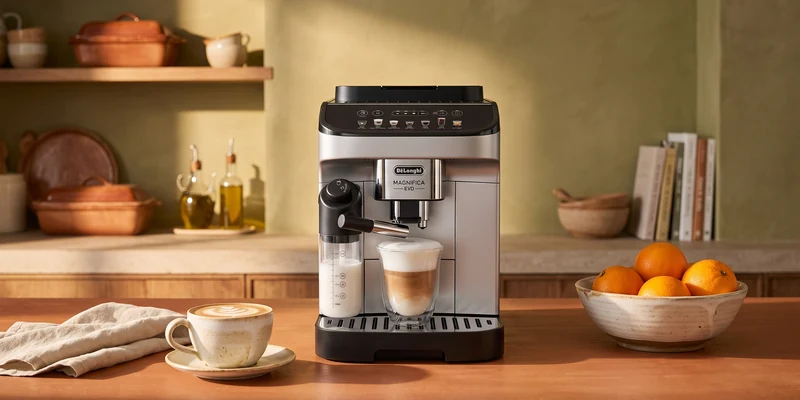
The Magnifica line is the most broadly useful machine De’Longhi makes, because it turns whole beans into coffee without asking anything of the user. In a household where several people make their own cup, it is the model that gets used every day.
✅ Beans to cup in one press, with an adjustable grinder built in
❌ Little control over the shot itself, and the brew unit needs regular rinsing

💸 Best Entry-Level Pick
The Stilosa is the least expensive honest way into portafilter espresso: a pressurized basket, a steam wand, and no illusions about being a cafe machine. It is the right choice when you want to find out whether making espresso appeals at all.
✅ Low commitment, simple to operate, works with pre-ground coffee
❌ Basic build and limited steaming power, so milk drinks take patience

📏 Best Slim Counter Fit
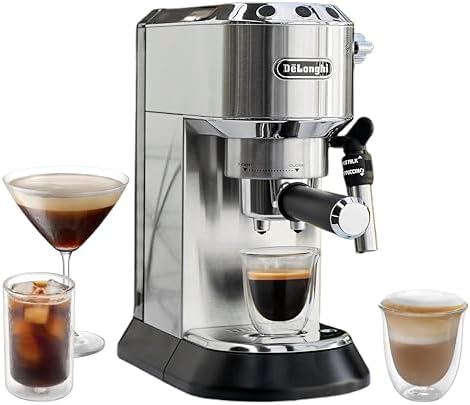
The Dedica was designed around narrow kitchens and still delivers the full portafilter routine, which makes it a favorite in apartments and small galley layouts. It looks purposeful rather than budget, which matters when it lives permanently on show.
✅ Unusually narrow body for a real espresso machine
❌ Small water tank and tight clearance around the cups and drip tray
Two More De’Longhi Machines Worth Considering
The three picks above cover convenience, curiosity, and small kitchens. Two more models answer a different question: what if you want to shape the shot yourself, with the grinder in the same box?
🎛️ Best for Dialing In Your Own Shot
The La Specialista Arte pairs a built-in conical burr grinder with non-pressurized baskets and a manual steam wand, the combination that lets you adjust grind, dose, and timing until a shot tastes the way you want. It suits someone who finds that process interesting rather than tedious.
✅ Grinder and real baskets in one machine, with room to improve for years
❌ Needs counter depth, and milk texturing is a skill you have to build

⭐ Upgrade Pick
The La Specialista Maestro sits at the top of the range, adding a grinder with more adjustment plus the automatic LatteCrema milk carafe to the same portafilter workflow. It suits the household that wants espresso done properly and cappuccinos done automatically.
✅ Manual shot control combined with automatic milk texturing
❌ The largest footprint here, and the milk system adds parts to clean

Cleaning, Descaling, and Long-Term Care
De’Longhi machines are straightforward to maintain, but the routine differs by type. Super-automatics want the removable brew unit rinsed regularly and the drip tray emptied often. Portafilter machines want the group rinsed, the basket cleaned, and the steam wand purged after every milk drink.
Descaling is the one you cannot skip
Mineral scale is a common reason home machines lose performance, and De’Longhi builds a descale indicator into most models for that reason. Use a descaler intended for espresso machines, follow the cycle the machine runs, and use filtered water if your supply is hard. Our roundup of the best descaling solutions for coffee machines covers what to buy.
Small habits that keep the machine consistent
Rinse the LatteCrema carafe after use rather than letting milk sit in it, knock the puck out promptly on portafilter models, and keep beans in a sealed container rather than in the hopper for weeks. None of it takes long, and it separates a machine that still performs in year three from one that quietly declines.
Common Mistakes to Avoid
- Buying a super-automatic when you wanted a hobby. If you were looking forward to learning espresso, the Magnifica takes the interesting part away.
- Expecting non-pressurized results from a pressurized basket. The Stilosa and Dedica make good coffee within their design, but they will not behave like the La Specialista line.
- Skipping the grinder question. A manual De’Longhi with pre-ground coffee is a compromise. If you want to improve, a grinder is the next purchase, not a bigger machine.
- Forgetting to measure the counter. The La Specialista models need depth and clearance for the cup and carafe. Check the space above the machine too.
- Ignoring the descale prompt. The indicator is not a suggestion. Running scaled up is a common cause of weak flow and early failure.
Where to Go From Here
If your budget shapes the decision, our tiered guides help more than a brand list: the best budget espresso machines covers the entry level honestly, the best espresso machines under 500 is where most De’Longhi shoppers land, and the best value espresso machines looks at what holds up over years. If the appeal of the Magnifica was really one-button convenience, compare it against pods in our guide to the best Nespresso machines first.
Frequently Asked Questions
What is the difference between the Magnifica Start and the Magnifica Evo? Both are super-automatics built on the same beans to cup idea with an integrated grinder; the Evo generally offers a broader drink menu and updated controls, while the Start keeps things simpler. Check the specific configuration on the listing, since De’Longhi sells several variants.
Is the Dedica good for a beginner? Yes, particularly if counter width matters. It uses a pressurized basket, so it is forgiving with pre-ground coffee, and the portafilter routine teaches the basics without demanding a grinder on day one.
Can I use pre-ground coffee in a De’Longhi espresso machine? In the Stilosa and Dedica, yes, because their pressurized baskets are designed for it. The La Specialista models expect freshly ground coffee you can adjust.
Which De’Longhi machine is best for lattes and cappuccinos? The models with the automatic LatteCrema system, including the La Specialista Maestro and several Magnifica variants, handle milk without technique. The Arte uses a manual wand, which gives better texture control once you learn it.
How often should I descale? Follow the machine’s descale indicator, which tracks your usage, and go sooner if your water is hard. Our guide to the best descaling solutions explains which products suit espresso machines.
The Bottom Line
The Magnifica is the right default for most households, because a super-automatic gets used by everyone and asks nothing in return. Choose the Stilosa or the Dedica to try portafilter espresso cheaply or to fit a real machine into a narrow kitchen, and step up to the La Specialista Arte or Maestro when you want to shape the shot yourself.