Last updated: August 13, 2026
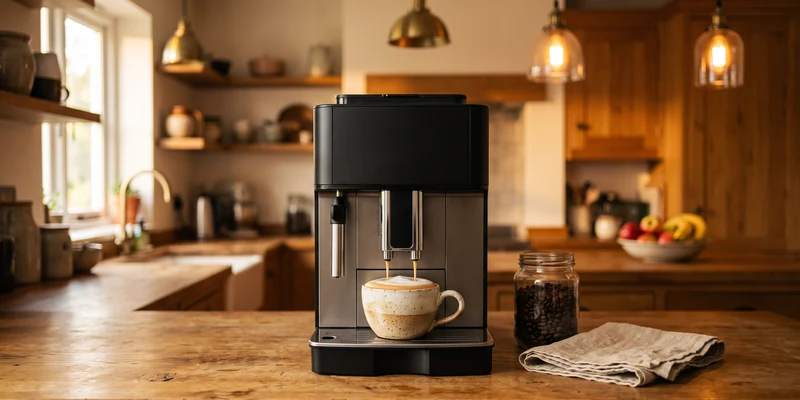
A super-automatic espresso machine, often sold as a bean-to-cup machine, does the entire drink from one button: it grinds fresh beans, doses them, compresses the puck, brews the shot, ejects the used grounds, and on most models steams or dispenses milk as well. You fill the hopper, fill the tank, press a picture of a latte, and walk away. For a household where several people want different drinks at different times, that convenience is the whole product.
The honest trade is control. You give up the ability to adjust dose and tamp by hand, and you accept the machine’s internal brewing routine in exchange for never having to think about it. This guide explains what actually differs between models (burrs, brew group access, milk systems, bypass dosers, cleaning routines), where the real long-term costs sit, and which widely available machines keep earning good word of mouth.
This article contains affiliate links. If you buy through them, we may earn a commission at no extra cost to you. Learn more.
Quick Answer
Which super-automatic espresso machine should you buy?
- For most households, a De’Longhi Magnifica Evo covers espresso and milk drinks with a removable brew unit that makes cleaning straightforward.
- If milk drinks are the main event, step up to a model with an automatic milk carafe so cappuccinos and lattes finish without touching a wand.
- If you want automation but refuse to give up a real portafilter, the Breville Oracle line grinds and tamps for you and still brews through a 58mm basket.
What Separates One Bean-to-Cup Machine From Another
Super-automatics all follow the same internal sequence, so the differences that matter are practical rather than dramatic: how the milk gets textured, whether you can remove and rinse the brew group yourself, how much of the grind you can adjust, and how much cleaning the machine asks of you each week. Those four questions predict long-term satisfaction better than any feature list.
| What to check | Why it matters | What to look for |
|---|---|---|
| Brew group | It is the part that gets coffee oils in it every single day | Removable brew units (De’Longhi, Gaggia, Philips) rinse under the tap; sealed units (Jura) rely on cleaning tablets |
| Milk system | Decides whether a latte is one button or two steps | Refrigerated carafe systems are the most hands-off, panarello wands are the simplest to clean |
| Burrs | Grind quality and noise | Conical burrs are standard here; ceramic and steel both work, so judge adjustment range and noise instead |
| Bypass doser | Lets you brew decaf or a different coffee without emptying the hopper | A small chute for pre-ground coffee, present on most mid-range models |
| Drink programming | Households rarely agree on strength or size | Per-user profiles and adjustable strength and volume per drink |
| Cleaning cycle | Where the ongoing cost really lives | Automatic rinse on power up and down, plus scheduled descaling and milk system cleaning with branded products |
Water hardness deserves a line of its own. Every heated machine scales, and super-automatics have more internal plumbing than a simple portafilter machine. Most brands sell a filter cartridge for the tank and prompt you when descaling is due. Our guide to descaling solutions for coffee machines covers what is safe to use where.
Super-Automatic vs Semi-Automatic: The Real Difference
The difference is not quality, it is where the decisions live. On a semi-automatic machine you own the grind, the dose, the tamp, and the shot timing, which means you can chase a specific result and also ruin a shot in four different ways. On a super-automatic, the machine makes those decisions with a fixed internal routine, so the ceiling is lower and the floor is much higher. Consistency comes free, and so does the loss of fine control.
In practice, choose by temperament, not by taste theory. If you enjoy adjusting variables and reading a shot as it pours, you will find a super-automatic frustrating no matter how good it is. If you want a good cappuccino before work without a routine, the automated route is not a compromise, it is the correct tool. Our semi-automatic espresso machine guide lays out the hands-on workflow in detail if you are still deciding.
Milk Systems: Carafe, Auto Wand, or Panarello
Milk is where super-automatic machines differ most in daily use. A refrigerated carafe system draws milk from an attached container, textures it, and pours it into the cup, usually with a dial for foam level. It is the most hands-off option and the one that needs the most disciplined cleaning, since milk residue in tubing is not something to postpone. Many carafes are designed to go straight into the refrigerator between drinks, which helps.
An automatic wand textures milk in a pitcher you place under it, so you still handle the pitcher but not the technique. A panarello wand is the simplest version: it introduces air mechanically to produce foam, which is easy to clean and easy to use, though the foam is airier than the dense microfoam a skilled hand produces on a manual wand. If cold foam for iced drinks is part of your routine, note that most built-in systems are built around hot milk; our cold foam frother guide covers the separate tools people use for that.
Our Top Picks at a Glance
How we chose: we compared widely available bean-to-cup machines on brew group access and cleaning, milk system type, grind adjustment, drink programming, and the patterns that repeat across owner feedback. Selections lean on manufacturer specifications and recurring themes in user reviews rather than any hands-on trial of our own.
One reassurance before the list: every machine here grinds whole beans fresh for each drink, which is the single biggest advantage this category has over capsules.
🏆 Best Overall
The mainstream bean-to-cup machine that gets recommended most often, and for good reason: a removable brew unit you can rinse under the tap, adjustable grind and strength, a bypass chute for pre-ground decaf, and a compact footprint for the category. Owners consistently mention how little maintenance friction it creates day to day.

🥛 Best for Milk Drinks
Step up to an integrated milk carafe and cappuccinos, lattes, and flat whites finish in one press, with a foam dial and a carafe that goes back in the refrigerator between drinks. The trade is a cleaning routine you have to respect, since milk tubing is not a component to neglect.

⭐ Upgrade Pick
The premium end of the category, with a refined grinder, a broad drink menu, and a brewing system built around a sealed internal unit that is cleaned with tablets rather than removed. Build quality and quiet operation are the recurring themes in owner feedback, along with a strong preference for staying on the maintenance schedule.

Picks by Situation: Simplicity, Easy Cleaning, and Control
The three above cover most households, but this category splits sharply by how much you want to touch the machine. These three fill the gaps.
💵 Best Straightforward Pick
An entry bean-to-cup machine with a manual steam wand instead of an automatic milk system. You lose one-touch lattes and gain a much simpler machine with fewer parts to clean. A sensible choice if espresso and the occasional cappuccino cover your household’s needs.

🧼 Best for Easy Cleaning
A removable brew group is the feature that separates a machine you maintain in two minutes from one that depends entirely on tablets and cycles. This pick pairs that access with a straightforward interface and a panarello-style wand, which rinses easily and is forgiving of an imperfect routine.

🎛️ Best Hybrid for Control
For people who want automation without giving up a real portafilter: this machine grinds, doses, and tamps automatically, then brews through a 58mm basket and handles milk texturing on its own. It is bigger and pricier than a conventional bean-to-cup machine, and it is the only route that keeps espresso accessories in play.

Beans, Grind, and What You Can Still Adjust
You cannot tamp on a super-automatic, but you are not without levers. Nearly all of these machines offer a grind adjustment inside the hopper, a strength setting that changes the dose, and a volume setting per drink. Those three cover most of the correction you will ever need. Adjust grind with the grinder running and in small steps, since the burrs are under load and large jumps can jam them.
Bean choice matters more here than people expect. Very oily dark roasts can clog hoppers and chutes over time, which is why many manufacturers advise against them, and flavored beans are widely discouraged for the same reason. Medium roasts with a dry surface behave best. If you want to understand grind size across every method, not just this one, the same particle logic that governs a bean-to-cup machine also governs a hand grinder, which our grinder guide for cold brew walks through from the coarse end.
Ongoing Cost and Maintenance Reality
The purchase is only part of the commitment. These machines expect water filters, descaling agents, and milk system cleaner on a schedule, and most will refuse to brew until a due cycle is completed. That is a feature, not a nuisance, since scale and milk residue are the two things that end these machines early. Budget for consumables as a normal part of ownership rather than a surprise.
Daily habits matter just as much. Empty the grounds bin and drip tray before they overflow, rinse the milk circuit after every session, and pull and rinse the brew group weekly if your machine allows it. If a machine reaches a point where cleaning no longer restores performance, service is usually a specialist job rather than a kitchen repair, which is worth knowing before you buy at the premium end.
Common Mistakes to Avoid
- Buying for the drink menu. Twenty programmed drinks impress in the showroom and change nothing about the cup. Buy on brew group access, milk system, and cleaning routine.
- Using very oily or flavored beans. They gum up hoppers, chutes, and burrs. Most manufacturers advise against them for exactly that reason.
- Postponing descaling prompts. Scale damage is cumulative and expensive. Treat the prompt as a deadline, not a suggestion.
- Neglecting the milk circuit. Milk residue in tubing is the fastest way to ruin both flavor and hardware. Run the cleaning cycle after every milk session.
- Expecting cafe-level control. If you want to chase specific extractions, this is the wrong category, and no amount of settings will change that.
Where to Go From Here
If the automation appeals but the price does not, capsule machines deliver similar convenience with a different set of trade-offs; our Nespresso machine guide and Keurig guide cover both ecosystems honestly. If the control question is still open, read the semi-automatic guide next and see which workflow you actually want to live with. And if a whole pot rather than a single drink is what your household really needs in the morning, the drip coffee maker guide is a better place to spend the money.
Frequently Asked Questions
Do super-automatic machines make good espresso? They make consistent espresso within a narrower range than a well-dialed manual setup. Freshly ground beans on every drink is a real advantage, while fixed internal dosing and tamping is the ceiling you accept.
What is the difference between super-automatic and automatic? A super-automatic grinds, doses, tamps, and brews on its own. An automatic machine is a portafilter machine that stops the shot at a programmed volume, so you still grind and tamp yourself.
Is a removable brew group important? It makes routine cleaning simpler, since you rinse the part that handles coffee oils directly. Sealed systems are cleaned with tablets and cycles instead, which works as long as you follow the schedule.
Can I use pre-ground coffee? Most models include a bypass chute for a single pre-ground dose, which is how people brew decaf without emptying the hopper. It is meant for occasional use rather than as the main path.
How often do these machines need descaling? It depends on water hardness and use, and the machine will prompt you. Setting the correct hardness level during setup and using the brand’s water filter both stretch the interval; see our descaling guide.
The Bottom Line
A super-automatic espresso machine trades control for consistency, and that is a good trade for households that want a drink now rather than a hobby. The De’Longhi Magnifica Evo is the balanced starting point, a carafe-equipped model is the answer if milk drinks dominate, and the Breville Oracle line is the hybrid for people unwilling to give up a real portafilter. Judge candidates on brew group access and milk cleaning, not on the size of the drink menu.