Last updated: July 2, 2026
Almost every American kitchen has had one, which is what makes the best drip coffee maker so slippery to shop for. The machines all look alike: a water tank, a basket, a carafe, a button. The gap between a forgettable pot and a good one comes down to two unglamorous questions. Does it heat water into the commonly recommended brewing range and hold it there, and does it wet the whole coffee bed instead of drilling a hole through the middle?
This guide sorts the category by household, because that drives everything else: one or two mugs a morning, a family or office pot that must stay drinkable for an hour, or the person who loves what a hand pour tastes like but will not stand over a kettle at 6 a.m. Then come the details that quietly change the cup, carafe, basket, filter, and water path.
This article contains affiliate links. If you buy through them, we may earn a commission at no extra cost to you. Learn more.
Quick Answer
Which drip coffee maker should you buy?
- Brewing for one or two, take a compact 4 to 5 cup machine. Big brewers rarely handle a thin bed well.
- Feeding a family or an office, choose a 10 to 12 cup machine with a thermal carafe and a timer.
- Chasing hand-pour clarity without the handwork, buy for brew temperature and a wide showerhead. That group comes closest to pour over.
What Separates an Average Drip Machine From a Good One
Two specifications do most of the work: brew temperature and water distribution. Water that never reaches the commonly recommended 195 to 205 F range (about 91 to 96 C) pulls sour, thin coffee from good beans, and water arriving through a single hole soaks a patch of grounds while the rest stays dry. Everything below follows from those two.
| What to check | Why it matters | What to look for |
|---|---|---|
| Brew temperature | Cool water gives sour, hollow coffee whatever the beans | A stated 195 to 205 F (about 91 to 96 C) range, held all cycle |
| Showerhead | A single drip point wets a channel, the rest stays dry | A multi-hole or spiral head that spreads water over the bed |
| Carafe type | A hot plate cooks; a vacuum carafe only holds heat | Thermal stainless if the pot sits past half an hour |
| Capacity | Machines brew best near their designed batch size | 4 to 5 cup solo, 8 to 10 household, 12 for an office |
| Basket shape | Cone and flat baskets extract differently | Cone for clarity, flat for forgiving daily brewing |
| Programmability | Decides whether coffee waits for you | A 24 hour timer, adjustable shutoff, brew-strength mode |
| Water path | Hot water sits in tank and tubing first | Glass, borosilicate, or stainless keeps plastic off the hot side |
| Cleaning | Scale slows flow and drags temperature down | A descale indicator, plus parts that come apart easily |
There is a shortcut through all of this. The Specialty Coffee Association certifies home brewers against a published standard, and the program targets what this table does: proper brew temperature, sensible contact time, even extraction. Certification is not the only route to a good cup, but it is an independent signal in a category full of marketing copy.
Temperature and the Showerhead, Explained
Inexpensive machines fail in one of two ways, neither visible on the box. Some never get the water hot enough, because a small heating element must keep up with a full tank. Others reach the range briefly and then sag as the tank drains, so the first third of the brew extracts properly and the rest does not. The cup tastes thin and sharp, and people blame the beans.
The second failure is the dispersion arm. Budget brewers often deliver water through one opening in the lid, carving a channel down the middle of the bed. Water is lazy: it follows what is already wet and runs around the dry edges. Baristas describe the fix simply, get all the grounds wet and keep them wet.
How to spot it on a product page
Makers that solved this tend to say so. Look for a rainmaker or spiral showerhead, a stated temperature range rather than a vague promise of optimal heat, and a pre-infusion or bloom phase. Listings silent on all three are silent for a reason.
Glass Carafe or Thermal: The Call Most People Get Backwards
If your pot sits for more than half an hour, a thermal carafe beats almost any other upgrade. Glass on a warming plate keeps heating coffee that already finished brewing, and reviews consistently mention the same result: a pot that was pleasant at 7 a.m. tastes flat and bitter by 8. A vacuum-insulated stainless carafe slows heat loss instead of cooking.
Glass still earns its place. You can see how much is left, it rinses easily, replacements are cheap, and if you finish the pot within twenty minutes the difference barely registers. Thermal carafes pour slowly, hide the level, and need a real cleaning habit, since oils build up where you cannot see.
Our Top Picks at a Glance
How we chose: we compared widely available drip machines on stated brew temperature behavior, showerhead design, carafe type, basket shape, and patterns that repeat across owner feedback. Selections lean on manufacturer specifications and recurring review themes, not any hands-on trial of our own.
One reassurance: every pick is a plain automatic brewer taking a standard paper filter and medium-ground coffee. None need proprietary pods or a subscription.
🏆 Best Overall
A 9 cup brewer built around the two things that matter most: a heating system aimed at the commonly recommended brew range and a rainmaker-style showerhead that wets the whole bed. A thermal carafe replaces the hot plate.

💰 Best Budget Pick
The familiar 12 cup programmable workhorse with a glass carafe: 24 hour timer, brew-strength control, pause-and-serve. It will not match a premium brewer on temperature stability, but it is dependable and easy to service.

⭐ Upgrade Pick
A hand-assembled 10 cup brewer with a copper heating element, a wide dispersion arm, and a manual drip-stop that slows contact time. It carries SCA certification, and it is the machine people mean when they say drip can taste like a hand pour.

Filters, Baskets, and What Sits in the Water Path
Basket shape and filter material change the cup more than buyers expect. A cone basket holds a deeper bed and generally gives a cleaner, more defined cup, closer to hand brewing. A flat basket spreads the coffee wider and forgives an uneven grind, which is why it dominates.
Filter material is the second lever. Paper traps more oils and fine particles, so the cup reads clearer and lighter in body. A permanent gold-tone mesh filter lets those oils through for more body and a little sediment, and saves buying papers. Neither is better in the abstract, and switching is the cheapest experiment in coffee.
Plastic in the water path
Most drip machines route hot water through a plastic reservoir and tubing, and makers typically specify BPA-free plastics there. Even so, some people prefer to limit plastic in the water path, and there are machines built with glass, borosilicate, or stainless parts instead. Our guides to plastic-free coffee makers and coffee makers with no plastic in the water path break down which parts are made of what.
Picks by Situation: Control, Heat Retention, Small Batches
The three above cover most kitchens. These three fill the gaps.
🎛️ Best for Control
For the person who wants to adjust rather than accept: selectable brew modes, adjustable temperature and bloom time, and both cone and flat baskets. The closest a plug-in brewer gets to dialing in a recipe, and it handles small batches too.
🍵 Best Thermal Carafe
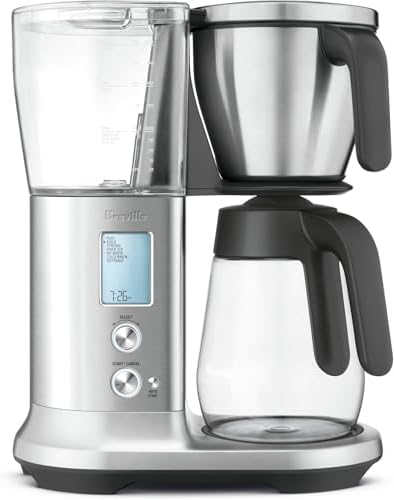
If the pot has to survive a slow morning or a shared office kitchen, vacuum-insulated stainless is the fix. The practical 10 cup setup: no warming plate cooking the coffee, no scorched taste an hour later, and a carafe you can carry.

👤 Best for One or Two
A compact 5 cup brewer that fits under a low cabinet and makes a batch small enough to drink fresh. It uses a permanent filter, so nothing to restock, and the footprint suits apartments, dorms, and offices short on counter space.

Grind, Dose, and Keeping the Machine Honest
Drip brewing wants a medium grind, roughly the texture of coarse sand. Too fine and the bed chokes, water backs up and the cup turns harsh; too coarse and the water runs straight through, leaving something weak and papery. A burr grinder holds a consistent particle size a blade grinder cannot, and it is the most effective purchase after the brewer. If you also brew immersion coffee, our guide to the best grinders for French press covers models that handle both settings.
For dose, most people land around 1:15 to 1:17, one gram of coffee per fifteen to seventeen grams of water. Start near the middle, adjust in one direction, and stay there a few days before judging. Weak coffee is more often a dosing problem than a machine problem.
Descaling is not optional
Mineral scale builds inside the heating element and tubing, and as it does, flow slows and brew temperature drops. That is how a machine that made good coffee for a year quietly stops. Most makers suggest descaling every one to three months depending on water hardness. Our walkthrough on cleaning a coffee maker with vinegar covers ratios and when a commercial descaler is better.
Common Mistakes to Avoid
- Buying a 12 cup machine to brew two cups. Large brewers are built around a full batch, and a thin bed extracts poorly.
- Leaving the pot on the warming plate. The plate keeps cooking coffee that finished brewing twenty minutes ago. Decant, or buy thermal.
- Waiting for a symptom before descaling. Scale degrades temperature and flow gradually, so put it on a calendar.
- Assuming every machine hits brew temperature. Many cheap brewers never reach the commonly recommended range. Treat a listing’s silence as information.
Where to Go From Here
If you are wondering whether an automatic brewer is the right format at all, there are three honest alternatives. A pour over setup gives the most control over temperature and pour rate for far less outlay, at the cost of five attentive minutes each morning. A percolator returns water to the bed near boiling, which is why many call that cup stronger and more robust. A single-serve pod machine trades cup quality for speed and zero cleanup.
If the deciding factor is what you can spend, our roundup of coffee machines under 100 covers what is realistic at the entry level, where the corners cut first are almost always the heating element and the showerhead.
Frequently Asked Questions
What water temperature should a drip coffee maker reach? The commonly recommended range is 195 to 205 F (about 91 to 96 C), held all cycle rather than touched briefly at the peak. Many inexpensive machines fall short or drop out of range as the tank empties, the usual cause of thin, sour drip coffee.
Is a thermal carafe worth it? If your pot sits for more than half an hour, yes. A warming plate keeps heating already-brewed coffee and pushes it toward flat and bitter, while a vacuum carafe only slows heat loss. If you finish quickly, glass is fine.
What grind size should I use in a drip machine? Medium, roughly the texture of coarse sand. Finer grinds slow the flow and can turn the cup harsh, coarser grinds run through too fast and taste weak. A burr grinder makes this easier to control, as our grinder guide explains.
How often should I descale a drip coffee maker? Every one to three months is the usual guidance, more often with hard water. Slower brewing, a noisier cycle, or coffee that tastes weaker all suggest you waited too long; the vinegar method handles most cases.
The Bottom Line
The right drip coffee maker is the one sized to your household and honest about its brew temperature: a compact machine for one or two, a thermal-carafe brewer for a family or office, and a certified, showerhead-driven model if you want hand-pour clarity without the handwork. Check two things before the feature list, whether it holds the commonly recommended range and whether it wets the whole bed. Then keep it descaled.