Last updated: April 29, 2026
Turkish coffee is one of the few brewing traditions where the coffee, the pot, the cup, and the conversation are treated as a single package. Nothing gets filtered out. The grounds go into the pot with the water, the whole thing warms slowly until foam rises, and what lands in front of you is a small, dense cup with a soft sediment at the bottom.
This guide covers what the tradition involves: the cezve that gives the method its shape, the powder-fine grind no ordinary burr setting will reach, the foam a cup is judged by, and the serving customs around it. It also places the closely related Greek, Bosnian, and Armenian preparations honestly, because that shared history deserves more than a footnote.
Quick Answer
What is Turkish coffee and how is it made?
- Very finely ground coffee, close to a powder, is combined with cold water (and sugar, if you want it) in a small long-handled pot called a cezve or ibrik, then heated slowly and served unfiltered.
- The goal is a stable layer of foam, called kopuk, on top of each cup. Low heat and no stirring once the pot warms up are what produce it.
- It is served in a demitasse with a glass of water and often a small sweet such as lokum, and the sweetness level is decided before brewing, not stirred in afterward.
Turkish Coffee at a Glance
Every detail below exists for a reason, and most are non-negotiable if the result is going to resemble what is served in Istanbul or Ankara. The grind and the heat level do the most work, so treat those two rows as the ones to get right first.
| Element | What the tradition uses | Why it matters |
|---|---|---|
| The pot | A cezve (also called an ibrik), narrow at the top, wide at the base, long handle | The tapered neck concentrates the foam; the long handle keeps your hand off the heat |
| The grind | Powder fine, noticeably finer than espresso, closer to flour | The coffee is never filtered, so it must extract quickly and settle cleanly |
| The ratio | Commonly around one heaping teaspoon per demitasse of cold water | The drink is meant to be small and concentrated; scaling it up changes its character |
| The heat | Low and patient, never a rolling boil | Fast heat blows the foam apart and pushes the pot over; slow heat builds and holds it |
| The sugar | Added at the start, in named levels from plain to very sweet | Stirring after brewing would disturb the sediment and collapse the foam |
| The cup | A small demitasse, traditionally called a fincan, with a saucer | The volume is deliberately small; the cup keeps it hot and frames the foam |
| The service | A glass of water alongside, often a piece of lokum or another small sweet | The water resets the palate; the sweet balances an unsweetened cup |
If you are shopping rather than reading, the pot changes the outcome most, and our roundup of the best Turkish coffee pots covers sizes, materials, and the capacity mistake nearly every first-time buyer makes.
The Cezve: Small Pot, Specific Job
A cezve has sloping sides, a narrow mouth, a pouring lip, and a long handle set at an angle. It is usually copper with a tin lining, though stainless steel is common and brass shows up too. The shape is not decorative: as the coffee heats, the narrowing neck traps rising foam in a smaller area, which lets it thicken instead of breaking.
Size matters more than buyers expect. A cezve works best filled between half and roughly two thirds, which means a pot sold as three cup is really a two cup pot. Buying too large is the most common regret, because a shallow pool in a wide pot produces thin foam and heats unevenly. The copper against stainless question is a genuine trade-off, and we break it down in the copper versus stainless comparison.
The Grind: Finer Than Espresso, and That Is the Hard Part
Turkish coffee uses the finest grind of any mainstream brewing method. Baristas generally describe the target as a powder that feels like flour or powdered sugar between your fingers, with no grittiness at all. That is meaningfully finer than espresso, and it is why so many home attempts fall flat: most grinders sold for drip and espresso do not close down that far.
There are three practical routes. A traditional cylindrical brass mill, sold across Turkey and the Balkans, is designed for this and nothing else. Many modern hand grinders reach a powder-fine setting, though consistency at that extreme varies by model. And this is one of the very few methods where a blade grinder is genuinely defensible, because you are pulverizing rather than chasing uniform particles. Pre-ground Turkish coffee in tins and vacuum bricks is also completely normal in Turkey. We sort the options in the guide to grinders for Turkish coffee.
Kopuk: Why the Foam Is the Whole Point
Ask a Turkish host what makes a good cup and the answer will almost certainly be the foam. Kopuk is the fine, tan layer that rises as the coffee warms, and a cup served without it is considered carelessly made. It is not crema and not milk foam; it forms from the fine grounds and dissolved gases as the liquid approaches, but never reaches, a boil.
Producing it comes down to restraint. The pot goes on low heat and is left alone. Many people stir once at the very start, then never again. As foam gathers, a common practice is to spoon a little into each cup first, return the pot to the heat until it rises again, then pour. What you never do is let the pot boil over, because a boiled cezve loses its foam and takes on a flat, scorched edge.
How to Brew It, Step by Step
The sequence below is the version taught in most Turkish homes. It rewards patience and punishes multitasking, so give it the four or five minutes it wants.
- Measure the water into the cup you will drink from. Fill the demitasse with cold water and pour it into the cezve. This keeps the ratio right across cup sizes.
- Add the coffee and the sugar together. Commonly around one heaping teaspoon of powder-fine coffee per cup, plus whichever sweetness level you want.
- Stir once, while it is still cold. Mix until the coffee is wet and the sugar dissolves, then put the spoon down for good.
- Heat slowly on a low flame. No stirring, no lid, no hurrying. Watch the surface rather than the clock.
- Spoon the first foam into the cups. When the surface lifts into a ring of foam, divide a little into each cup before the pot rises fully.
- Let it rise once more, then pull it off. Return the cezve to the heat until the foam climbs toward the rim, then remove it immediately.
- Pour slowly and let it settle. Pour down the side of the cup to protect the foam, then wait a minute or two before the first sip.
One habit separates people who enjoy Turkish coffee from people who tolerate it: stop drinking before you reach the bottom. The sediment is meant to stay in the cup.
Sweetness Levels and How to Order
Because sugar cannot be added afterward, Turkish coffee has a built-in vocabulary for sweetness, and being asked how you take it is part of the hospitality rather than a menu formality.
- Sade. Plain, no sugar at all. The most common choice among people who drink it daily.
- Az sekerli. Lightly sweetened, roughly half a teaspoon per cup.
- Orta sekerli. Medium, usually about a level teaspoon per cup, and the safe default if you are unsure.
- Cok sekerli. Very sweet, two teaspoons or more, and closer to a dessert than a morning cup.
Regional and household variation is real. Cardamom is added in some families and across much of the Levant, dibek coffee is stone-pounded rather than milled, and menengic, made from terebinth rather than coffee beans, is a Southeastern Turkish specialty served the same way despite not being coffee at all.
How It Is Served, and the Customs Around It
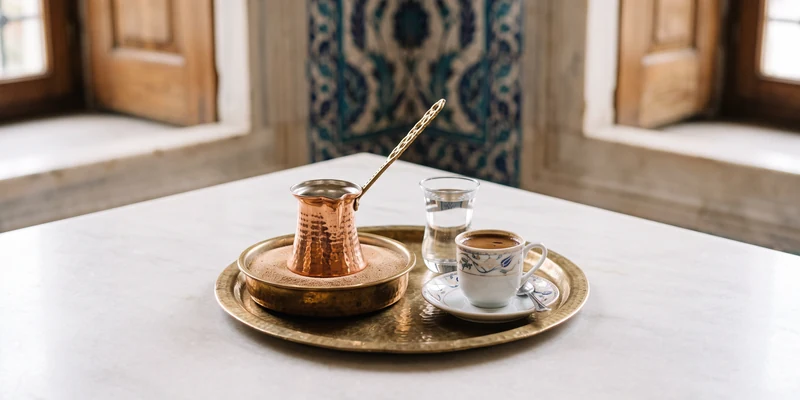
A proper serving is a small tray, not a single cup. The coffee arrives in a fincan on a saucer, with a glass of cold water beside it and very often a piece of lokum, the gel sweet known in English as Turkish delight. The water comes first, to clear the palate. The social frame runs deeper than the tray: Turkish coffee culture and tradition was inscribed on the UNESCO Representative List of the Intangible Cultural Heritage of Humanity in 2013, recognizing the practice as a marker of hospitality and friendship rather than simply a recipe.
Two customs come up constantly. The first is cup reading, known in Turkish as fal, where the empty cup is covered with its saucer, turned over, left to cool, and someone at the table interprets the shapes the sediment leaves. It is best understood as an after-coffee social pastime and a form of storytelling among friends, not as a means of predicting anything. The second is the coffee served at a formal engagement visit, where the bride-to-be traditionally prepares and serves it, and a widely enjoyed running joke has her making the prospective groom’s cup with salt instead of sugar to see whether he drinks it without complaint.
Greek, Bosnian, Armenian: One Method, Many Homes
The preparation described here is not exclusive to Turkey, and pretending otherwise would be inaccurate. Nearly identical methods are everyday practice across the Balkans, the Caucasus, the Levant, and North Africa, each with its own name and serving customs. Greek coffee is made in a briki. Bosnian coffee uses a dzezva and is traditionally served with the pot brought to the table alongside a separate cup. Armenian, Cypriot, Serbian, and Levantine versions each carry their own histories.
The technique is functionally the same, and the real differences sit in serving sequence, roast preference, and whether spices are used. Naming is a sensitive subject in several of these countries for reasons rooted in regional history, so the fair position is straightforward: these are related traditions that grew from a shared Ottoman-era practice, each fully at home where it is made, and none owes anyone a claim to be the original. If the Greek branch interests you, our Greek coffee guide covers the briki, kaimaki foam, and the frappe.
Common Mistakes to Avoid
- Using an espresso grind. The most frequent failure. Espresso fine still feels gritty in a cezve and gives you a thin cup with a rough sediment.
- Turning up the heat. High heat produces a fast rise, no lasting foam, and a scorched note. Low and slow is the entire technique.
- Buying a pot that is too big. A cezve wants to be half to two thirds full. Size it to the number of cups you usually make.
- Drinking to the bottom. Let the cup rest a minute or two after pouring and stop while there is still liquid above the sludge.
Where to Go From Here
If you are setting up for the first time, the order is simple: a correctly sized cezve, then a way to get a powder-fine grind, then cups. Our Turkish coffee pot guide covers capacity and material, the grinder guide deals with the part most people underestimate, and our piece on Cuban coffee in a moka pot shows how much regional character another small stovetop pot can carry.
Frequently Asked Questions
What is the difference between Turkish coffee and espresso? Espresso pushes hot water through a compressed puck under pressure and filters the grounds out. Turkish coffee is unfiltered: the grounds are heated together with the water and stay in the cup. The grind is also finer, and no pressure is involved at any stage.
Do you drink the grounds in Turkish coffee? No. The sediment settles at the bottom and is left behind. Give the poured cup a minute or two, then stop drinking while there is still clear liquid above the layer of grounds.
What grind size does Turkish coffee need? Powder fine, commonly described as flour-like or similar to powdered sugar, and noticeably finer than espresso. Many grinders cannot reach it; see our grinder guide for the options that can.
Why is Turkish coffee served with water? The glass of water lets you clear your palate before the first sip of a small, concentrated coffee. In many places it also signals hospitality, and drinking it first is the polite sequence.
Is Greek coffee the same as Turkish coffee? The brewing method is essentially the same, made in a small long-handled pot with powder-fine coffee and served unfiltered. The names, vessel terminology, sweetness vocabulary, and serving customs differ by country, and the naming itself carries historical weight in the region. Our Greek coffee guide covers that side in detail.
The Bottom Line
Turkish coffee is defined by four things: a powder-fine grind, a correctly sized cezve, low patient heat, and a layer of foam that tells you the first three were respected. Get those right and the rest, the demitasse, the glass of water, the piece of lokum, follows naturally. It is a tradition recognized by UNESCO as a form of hospitality as much as a way of making coffee, and it repays the few minutes it asks for.