Last updated: May 24, 2026
A Turkish coffee grinder has to do something almost no other grinder is asked to do: reduce coffee to a powder. Not espresso fine, which still has a sandy texture between your fingers, but genuinely fine, closer to flour or powdered sugar. Because Turkish coffee is never filtered, that particle size separates a smooth cup with a settled sediment from a weak, gritty one.
This is where most home setups fail, and it is rarely the pot’s fault. Most grinders sold for drip and espresso do not close down far enough, and running them at their finest setting produces something that looks close but tastes thin. This guide covers the grinder types that reach powder fine, the traditional mills built for the job, why a blade grinder is unusually defensible here, and how to read a spec sheet before you buy. If you are new to the method, start with our Turkish coffee guide.
This article contains affiliate links. If you buy through them, we may earn a commission at no extra cost to you. Learn more.
Quick Answer
Which grinder can actually grind Turkish coffee?
- A traditional cylindrical hand mill, the brass type sold across Turkey and the Balkans, is designed for exactly this grind and nothing else, which is why it remains the reliable answer.
- Many modern hand grinders can be dialed down to powder fine, though it takes patience to turn and consistency at that extreme varies by model.
- Turkish coffee is one of the few methods where a blade grinder is genuinely usable, because the goal is pulverizing rather than uniform particles.
Grinder Types for Turkish Coffee, Compared
The decision is less about brand than about mechanism, because only some designs physically reach the target. The table below sorts the realistic options by how well they handle a powder-fine grind and what you give up in each case.
| Grinder type | Reaches powder fine? | What to know |
|---|---|---|
| Traditional brass hand mill | Yes, it is the design intent | Cylindrical Turkish or Balkan mill with an internal adjustment nut; slow but purpose built |
| Modern manual burr grinder | Usually, at the very bottom of its range | Check the maker’s stated range, and expect noticeably harder cranking at the finest settings |
| Blade grinder | Yes, with enough run time | The one method where blades make sense; pulse in short bursts and let it cool between runs |
| Electric burr grinder, drip focused | Often no | Many popular models stop at or above espresso fine by design; confirm the manufacturer lists a Turkish or extra-fine setting |
| Electric burr grinder, espresso focused | Sometimes | Espresso-capable grinders go finer than drip models, but espresso fine is still coarser than Turkish; read the stated range rather than assuming |
| Spice or herb grinder | Yes, in practice | Mechanically similar to a blade grinder; keep it dedicated to coffee so flavors do not transfer |
| Pre-ground Turkish coffee | Yes, already done | Completely normal in Turkey and not considered a compromise; the trade-off is freshness once the vacuum pack is opened |
If you want the wider picture on hand grinders across brewing methods, our roundup of the best manual coffee grinders covers burr types, adjustment systems, and build quality in more depth.
How Fine Is Turkish Fine?
Baristas generally describe the target as a powder with no perceptible grit, similar in feel to flour or powdered sugar. Espresso, for comparison, is commonly described as feeling like fine table salt or sand: still granular between the fingers. That gap sounds small on paper and is enormous in practice, because the extraction has no pressure and no filter helping it along. In a cezve, the water simply sits with the grounds and warms, so the coffee has to be fine enough to give up its flavor on contact and light enough to settle into a clean layer afterward.
The finger test is the most useful check you have. Rub a pinch of ground coffee between thumb and forefinger. If you feel individual particles, it is still espresso territory and the cup will taste under-extracted with a rough sediment. If it smears like powder, you are in range. This costs nothing and beats a number on a grinder’s dial, since settings are not standardized between brands.
Why a Blade Grinder Is Not a Crime Here
Blade grinders have a poor reputation for good reason. They chop rather than mill, producing a mix of dust and chunks that ruins the even extraction pour over and espresso depend on. Turkish coffee changes the math. There is no filter bed to channel and no puck to compact, and the target is already the dust end of the spectrum, so the uniformity problem largely disappears.
That said, technique matters. Run the grinder in short pulses rather than holding the button down, tap it between bursts to move the coffee around, and let it cool if you are grinding more than a couple of cups. Heat is the real enemy with blades, and a long continuous run cooks the grounds before they are fine enough. Owners consistently report that two or three short sessions get them where a single long run does not.
Our Top Picks at a Glance
How we chose: we compared widely available grinders on whether they physically reach a powder-fine setting, adjustment mechanism, build quality, ease of cleaning fine dust, and the themes that repeat in owner feedback. Selections lean on manufacturer specifications and recurring review patterns rather than any hands-on trial of our own.
Before you scroll, one honest note: no grinder on this list is a bad tool for Turkish coffee, but they differ enormously in effort. The traditional mill is slow and satisfying, the blade grinder is fast and unromantic, and the modern hand grinders sit in between while also serving your other brewers.
🏆 Best Overall
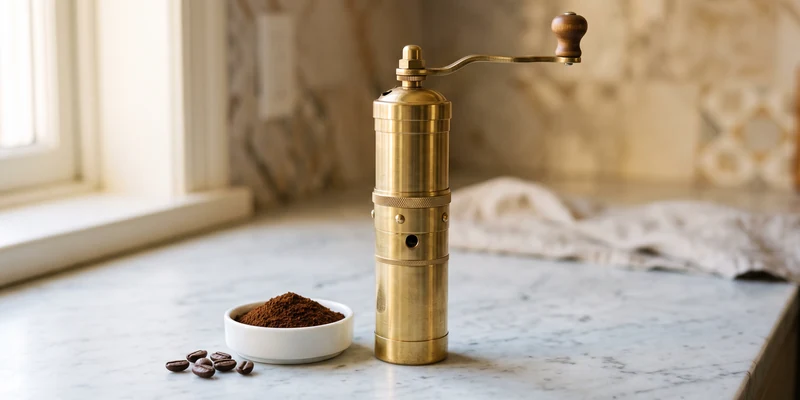
A traditional cylindrical brass Turkish coffee mill. Built for one grind size and calibrated to reach it, with an internal adjustment nut and burrs that handle powder fine without complaint. Slow, quiet, and about as reliable as kitchen equipment gets, with no batteries and nothing to break.

🔁 Best for Multiple Brew Methods
A modern stainless burr hand grinder such as the Timemore Chestnut series. It handles pour over and French press at the coarse end and can be dialed most of the way to powder for a cezve, which makes it the sensible single-grinder answer for a mixed kitchen. Expect the crank to get stiff at the finest settings.

💰 Best Budget Pick
A simple electric blade grinder. Unfashionable, but this is the rare method where the mechanism suits the task, and it costs a fraction of a burr grinder. Pulse it in short bursts, tap between runs, and check the texture with the finger test before you stop.

Picks by Situation: Volume, Electricity, and Everyday Use
Three more options for buyers whose situation does not fit the main list: households that grind for several cups at a time, people who want an electric burr grinder specifically, and anyone building a wider coffee setup.
⚡ Best Electric Burr Option
An electric conical burr grinder whose manufacturer explicitly lists a Turkish or extra-fine setting. This is the detail to verify rather than assume: plenty of well regarded burr grinders, including popular drip-focused models, stop at espresso fine by design and will not reach powder. If the range is not stated, treat that as a no.
👥 Best for Grinding Several Cups
A larger-capacity manual mill or a blade grinder with a bigger chamber. Turkish coffee is measured in small doses, but serving four people still means grinding four doses at a powder-fine setting, which is slow work on a compact hand grinder. Capacity is the spec that saves your wrist here.

🧰 Also Great: The All-Rounder Hand Grinder
A ceramic burr hand grinder such as the Hario models, widely owned and easy to clean. It is more comfortable to turn than most stainless designs at coarse settings and will get close to powder with effort, making it a reasonable compromise if Turkish coffee is one method among several you brew.

Buying Pre-Ground Instead
Skipping the grinder entirely is a legitimate route, and worth saying plainly because English-language coffee writing tends to treat pre-ground as a failure. In Turkey, vacuum-packed bricks and tins of finely ground coffee are how most households buy it. The grind is correct out of the package, which removes the single biggest obstacle for a home brewer in the United States.
The trade-off is the usual one. Ground coffee stales faster than beans, so buy small packages and keep them sealed, away from heat and light. If you drink Turkish coffee occasionally rather than daily, pre-ground is arguably the better call, and you can always add a grinder later.
Cleaning and Living With a Fine-Grind Setup
Powder-fine coffee gets everywhere. It packs into burr threads, coats blade chambers, and clings to any plastic surface with a static charge. A dry brush kept beside the grinder handles most of it, and a periodic disassembly of a hand grinder, following the maker’s instructions, clears the rest. Avoid washing burrs with water unless the manufacturer says the parts are safe for it.
Two habits keep results consistent. Grind only what you are about to brew, and reset the grinder to your Turkish setting deliberately each time if you also use it for other methods. If you find yourself constantly sliding between pour over coarse and powder fine, that is the argument for owning a dedicated Turkish mill alongside your main grinder.
Common Mistakes to Avoid
- Assuming espresso fine is fine enough. It is not. The finger test settles it in two seconds: any perceptible grit means keep going.
- Buying a burr grinder without checking the range. Many well regarded models stop above Turkish fine by design. Look for an explicit Turkish or extra-fine claim.
- Running a blade grinder continuously. Long runs heat the grounds. Pulse, tap, rest, repeat, and check texture rather than watching the clock.
- Grinding a large batch in advance. Powder-fine coffee goes flat quickly. Grind per brew, or buy vacuum-packed and open one small package at a time.
- Skipping cleaning. Fine dust cakes into burrs and dulls performance faster than coarse grinding does. A brush after each session is enough.
- Blaming the pot. A flat, gritty cup is almost always a grind problem, not a cezve problem. Our pot guide covers when the vessel really is the issue.
Where to Go From Here
With the grind sorted, the next decisions are the pot and the technique. Our Turkish coffee pot guide explains sizing and materials, the copper versus stainless comparison settles the material debate, and the Turkish coffee guide walks through brewing and serving. If this grinder will also serve other methods, the manual grinder roundup and our guide to grinders for cold brew cover the opposite end of the range, which is a useful reference point for understanding how wide a grinder’s span really is.
Frequently Asked Questions
How fine should Turkish coffee be ground? Powder fine, commonly compared to flour or powdered sugar, and noticeably finer than espresso. Rub a pinch between your fingers: if you feel individual grains, it is still too coarse for a cezve.
Can I use a regular coffee grinder for Turkish coffee? Only if it reaches a powder-fine setting, which many drip-oriented burr grinders do not. Check the manufacturer’s stated grind range, and if Turkish or extra-fine is not listed, assume it will not get there.
Is a blade grinder okay for Turkish coffee? Yes, unusually so. Uniform particle size matters far less here because the coffee is never filtered. Pulse in short bursts, tap the grinder between runs, and stop when the texture passes the finger test.
Do I need a special Turkish coffee mill? You do not need one, but the traditional brass mills are built for this grind and reach it reliably. They are slow, which is why some households keep one alongside a faster grinder for other brewing methods.
Is pre-ground Turkish coffee acceptable? Completely. Vacuum-packed fine grind is how most households in Turkey buy it. Buy small packages, seal them well, and keep them away from heat and light, since fine coffee stales faster than beans.
Why does my Turkish coffee taste weak and gritty? Almost always the grind. Coffee that is coarser than powder under-extracts in the short, gentle heating a cezve provides and leaves a rough sediment instead of a smooth one. Fix the grind before changing anything else.
The Bottom Line
The best grinder for Turkish coffee is whichever one actually reaches powder fine, and that rules out more equipment than most buyers expect. A traditional brass mill is purpose built and dependable, a modern hand grinder covers Turkish plus your other methods with some effort, and a blade grinder is a legitimate budget answer in this one method. Verify the grind range before you buy, use the finger test to confirm, and remember that vacuum-packed pre-ground is a perfectly respectable shortcut.