Last updated: July 20, 2026
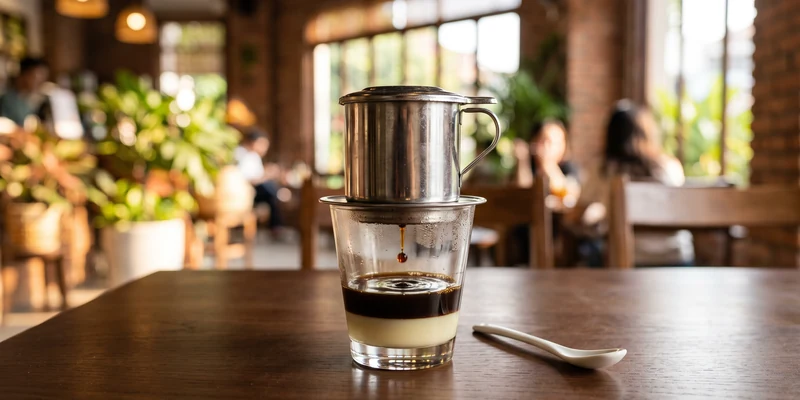
The classic recipe for Vietnamese coffee has only four moving parts: dark robusta coffee, a small metal filter called a phin, sweetened condensed milk, and patience. That last ingredient is the one most people skip. A phin does not rush. It sits on top of your glass and drips for four or five minutes while you do nothing at all, and the result is a cup so thick and sweet that a single small glass feels like a whole coffee break.
This guide walks through the drink the way it is actually made in Vietnam, from the grind that keeps the filter from clogging to the reason condensed milk became standard in the first place. You will also find the variations worth knowing, the mistakes that produce a bitter or watery cup, and what to do if you do not own a phin yet.
Quick Answer
How do you make Vietnamese coffee at home?
- Put sweetened condensed milk in the glass first, set the phin filter on top, add roughly two to three tablespoons of medium-coarse dark roast, and pour just-off-boil water in two stages.
- Let it drip for about four to five minutes without touching it, then stir the coffee into the milk and pour the whole thing over a tall glass of ice.
- Robusta or a robusta-heavy blend is traditional, because its heavy body stands up to the milk instead of disappearing into it.
Vietnamese Coffee, Step by Step
This is the standard method for cà phê sữa đá, the iced milk coffee that most Americans mean when they say Vietnamese coffee. Everything below scales to one glass, which is how a phin is designed to work.
- Start with the milk, not the coffee. Spoon one to two tablespoons of sweetened condensed milk into the bottom of a heatproof glass or a small cup. Putting it in first means the hot coffee lands on top of it and dissolves it for you. Adjust to taste: some people go lighter, and street stalls in Vietnam are often generous.
- Rinse and warm the phin. Pour a little hot water through the empty filter and let it run into the glass or the sink. This warms the metal so it does not steal heat from your brew, and it flushes any dust from the chamber.
- Add the coffee and level it. Two to three tablespoons of ground coffee is the usual dose for a standard phin. Tap the filter gently on the counter so the bed sits flat, then set the insert press on top. Screw-down presses only need light pressure, and gravity presses simply rest on the grounds.
- Bloom it. Pour just enough hot water to wet all the grounds, roughly a tablespoon or two, and wait about thirty seconds. The bed swells and settles. Skipping this step is the most common reason a phin drips unevenly.
- Fill the chamber and cover it. Top the phin up with water that has come off the boil, water around 195 to 205 degrees Fahrenheit is the range most brewers aim for, then put the lid on to hold the heat in.
- Wait, and do not poke it. A well-set phin drips steadily for about four to five minutes. Fast drips mean the grind is too coarse or the press is too loose; a stalled filter usually means the grind is too fine or the press is screwed down too hard.
- Stir, then ice. Lift the phin off, set it on the lid turned upside down, and stir the dark coffee into the condensed milk until the color turns to caramel. Pour over a glass packed with ice, or drink it hot as cà phê sữa nóng.
The whole process takes about seven minutes start to finish, and almost all of it is waiting. If you want to try the same coffee in a very different form, the whipped yolk cream in Vietnamese egg coffee starts from exactly this brew.
Why Robusta and Condensed Milk
Both signatures of the drink come from history rather than preference. French colonists introduced coffee to Vietnam in the mid 1800s, and the phin is a close relative of the small single-cup metal drip filters used in France at the time. Fresh dairy was scarce and difficult to keep in a hot climate, so shelf-stable sweetened condensed milk took its place, and it never left.
The bean choice has a similar logic. Vietnam’s growing regions, especially the Central Highlands around Buon Ma Thuot, suit robusta, and the country is now the world’s largest robusta producer. Robusta brews darker, heavier, and more bitter than arabica, with a rubbery, chocolatey edge that arabica fans sometimes dislike on its own. Poured through a phin and stirred into condensed milk, that heaviness is the whole point: it survives the sugar instead of being buried by it. Many roasters aimed at this style sell a blend rather than pure robusta, which softens the bitterness without losing the body. Our guide to the best coffee beans for Vietnamese coffee covers what to look for on the bag.
Grind Size: The Setting That Decides Everything
A phin has no paper filter and no pump, so grind size is the only real control you have over extraction. The commonly recommended target is medium-coarse, similar to a slightly coarse drip grind and noticeably coarser than espresso. Ground too fine, the bed compacts and the filter either stalls completely or produces a few bitter drops. Ground too coarse, water rushes through in ninety seconds and you get a thin, sour cup that the condensed milk then flattens.
Preground Vietnamese coffee sold for the phin is usually milled to roughly this size already, which is why it works straight from the bag. If you are grinding at home, start medium-coarse and adjust in small steps, using drip time as your feedback: aim for a slow, steady drip that finishes in four to five minutes, and change one thing at a time. The same logic applies to almost every brewer, which is why grind gets so much attention in our grinder guide for cold brew too.
The Phin Itself, and What to Do Without One
A phin has four parts: a saucer that catches drips, a perforated brewing chamber, an insert that sits on the coffee bed, and a lid. Two insert styles are common. The gravity press simply rests on the grounds under its own weight, which is forgiving for beginners. The screw press threads down onto a post and lets you tighten the bed, which gives more control and more ways to get it wrong. Aluminum phins are cheap and heat up fast; stainless versions hold heat better and resist denting.
No phin? You have workable substitutes, though none are identical. A moka pot produces a concentrated brew that takes condensed milk beautifully, which is why the same trick shows up in Cuban coffee, as covered in our guide to Cuban coffee in a moka pot. A small French press with a dark robusta blend gets you close on body if you keep the steep short. An espresso shot over condensed milk is the fastest approximation, but it lands sweeter and sharper than the real thing because the phin brew is longer and less intense per ounce.
The Rest of the Family
Cà phê sữa đá is the famous one, but it is a member of a group, and knowing the names makes ordering easier whether you are in Hanoi or a Vietnamese cafe in Orange County.
| Name | What it is | Good to know |
|---|---|---|
| Cà phê sữa đá | Phin coffee stirred into sweetened condensed milk, poured over ice | The default iced drink; sweetness varies a lot by shop |
| Cà phê sữa nóng | The same drink served hot, in a small glass | More common in the cooler north than in the south |
| Cà phê đen đá | Black phin coffee over ice, usually with a little sugar | Shows the roast clearly, so bean quality matters more |
| Cà phê trứng | Egg coffee: whipped yolk and condensed milk over hot coffee | A Hanoi specialty; see our full explainer |
| Bac xiu | Milk-forward version with more condensed milk and less coffee | Southern in origin, often described as the gentle option |
| Cà phê muoi | Salt coffee, with a lightly salted cream layer | Associated with Hue, now popular well beyond it |
Regional habits differ, and no version is more correct than another. Southern Vietnam leans sweeter and colder, the north drinks more of its coffee hot and black, and every cafe has its own house ratio.
Common Mistakes to Avoid
- Grinding for espresso. The single biggest cause of a stalled phin. Medium-coarse is the target, and preground phin coffee already sits there.
- Cranking the screw press down. The insert is there to keep the bed even, not to compress it like a portafilter. Finger-tight is plenty.
- Using boiling water straight off the heat. Let the kettle rest for thirty seconds or so. Full boil scalds a dark roast and pushes the cup toward ash.
- Lifting the lid to check. Every peek drops the temperature inside the chamber and slows the drip further. Trust it.
- Adding ice to the phin drip. Brew first, stir, then pour over ice. Dripping straight onto ice dilutes the coffee while it is still brewing.
- Treating condensed milk as optional sugar. Evaporated milk and regular milk are not substitutes; the sweetened condensed version carries both the sugar and the texture.
Where to Go From Here
Once the basic cup is reliable, there are two natural directions. The first is the bean: switching from a supermarket blend to a proper dark robusta or robusta-arabica blend changes the drink more than any technique tweak, and our bean guide sorts the options. The second is the drink itself. Hanoi’s egg coffee turns the same brew into something closer to dessert, and if you want the flavor on a weekday morning with no equipment at all, the 3-in-1 sachets covered in our instant Vietnamese coffee guide are how a large share of Vietnam actually drinks coffee on the go.
Frequently Asked Questions
How much coffee goes in a phin? Roughly two to three tablespoons for a standard single-serve phin, filled with water to the top of the chamber. Larger phins exist for sharing, and they scale the same way.
Can I use regular arabica coffee? Yes, and it will taste good, just not traditional. Arabica brews lighter and sweeter, so it tends to get lost under condensed milk. A robusta-heavy blend is the usual choice for that reason.
Why is my phin dripping so slowly, or not at all? Almost always the grind is too fine or the press is screwed down too tight. Loosen the press first, and if the next brew still stalls, go one step coarser on the grinder.
Is Vietnamese coffee stronger than regular coffee? It is more concentrated per ounce than drip coffee and robusta typically carries more caffeine than arabica, but the serving is small. Strength depends on your dose, your grind, and how much you drink.
What can I use instead of condensed milk? Nothing matches it exactly. A sweetened condensed coconut milk is the closest common substitute for a dairy-free version, and it keeps the syrupy texture that regular milk cannot.
The Bottom Line
Vietnamese coffee is a slow drip of dark, robusta-heavy coffee stirred into sweetened condensed milk and poured over ice. Get the grind medium-coarse, leave the press loose, and let the phin take its four or five minutes. Those three habits turn a fussy little filter into the most reliable coffee ritual in your kitchen.