Last updated: August 12, 2026
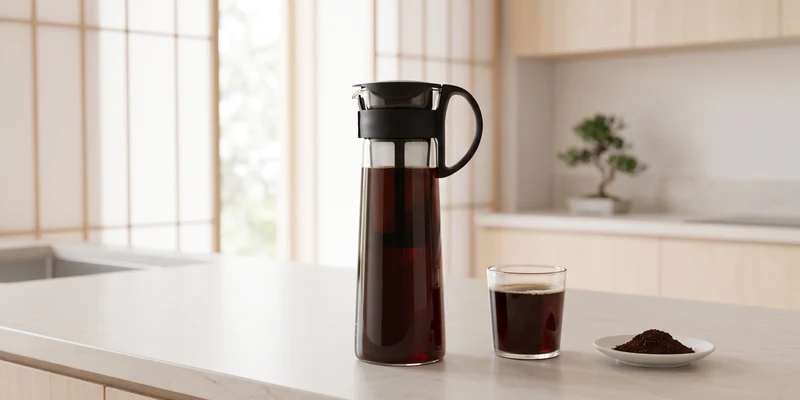
If you have been looking for a cold brew coffee maker from Hario, the Mizudashi is almost certainly what you found: a slim glass carafe with a long mesh filter down the middle, a colored lid, and nothing else. It is the same design philosophy that made the Hario V60 a fixture on coffee bars, applied to the least complicated brewing method there is.
This review looks at what that minimalism gets right, where a mesh filter shows its limits, and who should choose it over the plastic pitchers and countertop systems it competes with. It is an assessment of the product’s design and of recurring themes in owner feedback rather than firsthand use of our own.
This article contains affiliate links. If you buy through them, we may earn a commission at no extra cost to you. Learn more.
Quick Answer
Is the Hario Mizudashi a good cold brew maker?
- Yes, if you want glass rather than plastic, a small footprint, and coffee you pour straight from the fridge without diluting anything.
- It brews at drinking strength rather than as a concentrate at typical ratios, which is a feature for some people and a limitation for others.
- Skip it if you need a large batch, if you want a very clean cup, or if a breakable carafe in a busy kitchen makes you nervous.
Hario Mizudashi at a Glance
The Mizudashi is immersion brewing stripped to three parts. The filter cylinder holds the grounds, the glass carafe holds the water, and the lid keeps it all sealed while it sits in the fridge.
| Category | What to know |
|---|---|
| Brew method | Immersion in the fridge, with grounds held in a removable filter cylinder |
| Materials | Heat resistant glass carafe, polypropylene filter and lid |
| Filtration | Fine mesh only, reusable, no paper stage |
| Output | Usually ready to drink strength at common ratios, though a stronger ratio gives a concentrate |
| Sizes | Offered in more than one capacity, so check the listing against how much you drink |
| Cleanup | Three pieces, quick to rinse, and the filter is easy to empty |
| Ideal for | Solo drinkers, glass preferrers, small fridges and tidy counters |
| Less ideal for | Households, sediment sensitive drinkers, homes where glass gets knocked over |
Hario is best known for the V60 pour over cone, and the Mizudashi shares its outlook: solve one job with as few parts as possible and let the coffee do the rest.
What the Mizudashi Gets Right
Glass in the water path is the first draw. Aside from the filter cylinder and lid, the coffee only touches glass, which matters to buyers who would rather not brew and store in plastic; our roundup of plastic free coffee makers covers that preference properly. It also means the carafe washes clean without holding onto flavors from last week’s beans, which plastic pitchers occasionally do.
Simplicity is the second. Three parts, no assembly, no consumables, and a shape that fits a fridge door or a narrow shelf. Because it typically brews at drinking strength, there is no dilution step either: you pour it over ice and you are done. Owners consistently mention that this is the one they use on weekday mornings precisely because nothing about it requires thought. A coarse, even grind is what keeps the mesh working well, which is why a burr grinder is the accessory that matters most here; see our cold brew grinder guide.
Where the Mizudashi Falls Short
Mesh filtration is the honest trade. A fine screen holds the grounds but not the fines, so the cup carries more body and more sediment than a paper or felt filtered brewer produces, and it is most noticeable in the last pour. Grinding a little coarser helps, and some owners pour the finished coffee through a paper filter when they want it crystal clear. Grinding too fine does the opposite: it clouds the coffee and slows the filter down.
Capacity and fragility are the other two. This is a modest batch by design, which is fine for one person and thin for a household, and glass is glass. The narrow shape that makes it fit a fridge door also makes it easier to tip on a crowded shelf. And because it brews at drinking strength, it does not stretch the way a concentrate does when you have guests.
How It Compares
Against the Takeya Cold Brew Maker, the two are direct rivals: the Hario gives you glass and a slimmer look, the Takeya gives you a shatter resistant body and a tighter seal, and both filter through mesh alone. Against the OXO Cold Brew Coffee Maker, the OXO is clearly the cleaner cup thanks to its paper stage, at the cost of counter space and consumables. And against the Toddy Cold Brew System, this is a scale question, since Toddy exists to make several days of concentrate at once. Our best cold brew coffee makers guide lines all four up.
Check It Out
How we chose: the standard Hario Mizudashi cold brew pot is the version owner feedback describes, and the one most buyers compare against plastic pitcher brewers.
🏆 The Minimalist Glass Pick
Three parts, a heat resistant glass carafe, and a long mesh filter that brews in the fridge and pours straight into the glass. It is the cold brew maker for people who want the method without the hardware.
✅ Glass in the water path, tiny footprint, nothing to buy again
❌ Breakable, modest capacity, and mesh only filtration shows fines

Who It Is For, and Who Should Skip It
Buy the Mizudashi if you are brewing for one or two, if you prefer glass to plastic, and if you would rather pour and drink than dilute a concentrate every morning. It rewards coarse, even grounds and a steep in the usual range, which for most people means somewhere between eight and twenty four hours in the fridge, with longer giving a heavier cup.
Skip it if you need volume, if sediment in the last pour bothers you, or if a glass carafe in a busy household sounds like a matter of time. The first two point at the Toddy and the OXO, the third at a plastic pitcher.
Alternatives Worth Considering
Three directions, depending on which Mizudashi limitation matters most to you.
🧊 Same Idea, Harder to Break
A sealed Tritan pitcher with a mesh filter core that brews and stores in the fridge door, with a silicone grip and a lid that seals tight enough to brew on its side. The pragmatic answer in a household with kids or crowded shelves.
✅ Shatter resistant, dishwasher safe, and easy to handle
❌ Plastic rather than glass, and the same mesh only filtration

🔎 If Sediment Is the Dealbreaker
A two stage immersion brewer that runs the coffee through mesh and paper before releasing it into a glass carafe. The clearest concentrate in the immersion category, and the obvious upgrade if you drink it black.
✅ Very low sediment and an even water distribution design
❌ Real counter space and paper filters as an ongoing purchase

🍶 When One Carafe Is Not Enough
The classic full immersion system with a reusable felt filter and a glass decanter, built to brew several days of concentrate in a single session. The household answer, with the softest profile of the group.
✅ Large batch output and a smooth, rounded cup
❌ Bulky, and the felt filter needs rinsing, wet storage, and replacing

Frequently Asked Questions
Does the Hario Mizudashi make concentrate? At common ratios it brews closer to drinking strength, so you pour it over ice without diluting. Use more coffee to water and you get something closer to a concentrate.
How long should it steep? Treat it as a range rather than a rule. Many people leave it in the fridge somewhere between eight and twenty four hours, tasting along the way, and Hario’s own guidance is a fine starting point.
Why is my cold brew cloudy? Almost always the grind. A coarse grind is commonly recommended for immersion brewing, because fines pass straight through a mesh filter. Our grinder guide explains what to look for.
Is the whole thing glass? The carafe is heat resistant glass; the filter cylinder and lid are plastic. If keeping plastic out of the water path entirely matters to you, see our plastic free coffee makers roundup.
Can you brew tea in it? Yes, the filter works with loose leaf tea, which is a common secondary use. Rinse it thoroughly between uses so the flavors do not carry over.
The Bottom Line
The Hario Mizudashi is the cold brew maker for people who want glass, a small footprint, and coffee they can pour straight from the fridge. Mesh only filtration means a fuller, siltier cup than a paper filtered brewer gives, and a coarse grind does most of the work of managing that. For one or two drinkers who value simplicity, it is very hard to beat.