Last updated: August 13, 2026
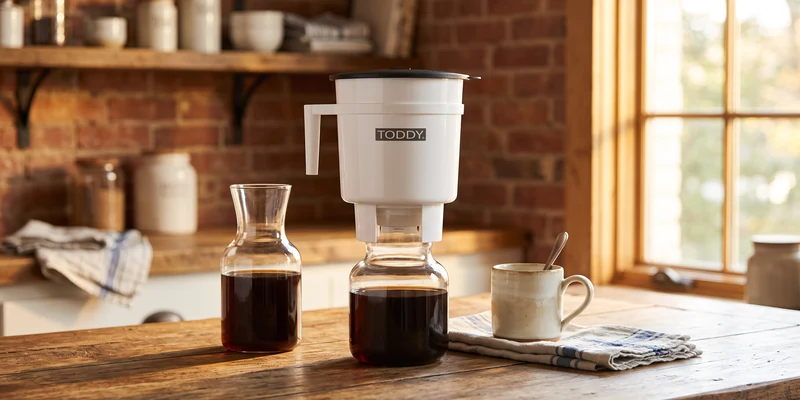
The Toddy cold brew coffee maker is the closest thing this category has to an heirloom. It arrived in American kitchens decades before cold brew became a menu item, and the design has barely changed: a brewing container, a rubber stopper, a reusable felt filter, and a glass decanter. No electronics, no switch, no app. That longevity is the reason it still shows up in coffee shop back rooms as often as it does on home counters.
This review reads the Toddy the way a careful buyer would: what that old design still does better than newer rivals, what the felt filter really asks of you, and who is genuinely better served by something smaller. It is an assessment of the system’s design and of recurring themes in owner feedback rather than firsthand use of our own.
This article contains affiliate links. If you buy through them, we may earn a commission at no extra cost to you. Learn more.
Quick Answer
Should you buy the Toddy Cold Brew System?
- Yes, if you want a large batch of smooth concentrate at once and you like the idea of a brewer with almost nothing to break.
- The reusable felt filter is the trade: it gives the Toddy its soft, rounded character, and it needs rinsing, storing wet, and replacing over time.
- Skip it if you drink a cup or two a week, or if a bulky brewing bucket has nowhere to live in your kitchen.
Toddy Cold Brew System at a Glance
The Toddy is a full immersion brewer in its simplest possible form. Grounds and water go in the brewing container with the stopper in place, the whole thing steeps on the counter, and then you pull the stopper and let gravity pull the coffee through the felt filter into the glass decanter.
| Category | What to know |
|---|---|
| Brew method | Full immersion at room temperature, drained by gravity through a felt filter |
| Materials | Plastic brewing container, silicone stopper, glass decanter with lid, reusable felt filter |
| Filtration | Bonded felt filter, reusable and washable, sold separately as a replacement |
| Output | Concentrate, stored in the decanter in the fridge and diluted to taste |
| Batch size | Large, built around brewing several days of coffee in one session |
| Cleanup | Easy container rinse, but the filter needs careful rinsing and correct storage |
| Ideal for | Daily drinkers, multi person households, anyone who batches ahead |
| Less ideal for | Occasional drinkers, tiny kitchens, people who dislike filter upkeep |
Toddy sells replacement felt filters and paper filter inserts for the same system, which matters because filter care is the single biggest variable in owning one.
What the Toddy Gets Right
Batch size is the practical headline. The Toddy is built to brew a decanter of concentrate that carries a household through several days, which changes cold brew from a project into a habit. Owners who drink it daily consistently mention that brewing once a week and pouring from the fridge every morning is the reason they stuck with the system, while smaller pitcher brewers had them starting over every other day.
Flavor character is the other reason it endures. Felt is a heavier filter medium than paper or mesh, and the cup it gives is generally described as rounder, softer, and lower in perceived acidity than the same beans through a mesh brewer. Whether that reads as smooth or as slightly muted depends on your taste and your beans, and a coarse, even grind gives it the best chance either way, which is why a burr grinder pays off more here than a fancier brewer would; see our cold brew grinder guide.
Where the Toddy Falls Short
The filter is the honest catch. A reusable felt filter has to be rinsed thoroughly after every batch and then stored wet, usually in a sealed bag in the fridge, because letting it dry out is what ruins it. Owners who follow that routine report years of service, and owners who do not report exactly what you would expect. Felt filters are also a wear item, so budget for replacements as part of ownership rather than treating them as a one time purchase.
Size is the second limitation. This is a bucket, a decanter, and a lid, and it does not tuck away neatly. If you brew a couple of cups a week, the Toddy is more system than the habit deserves, and the concentrate will sit in the fridge past its best. The design is also unapologetically utilitarian, so if the brewer is going to live on an open counter, some buyers prefer glass and stainless alternatives on looks alone.
How It Compares
Against the OXO Cold Brew Coffee Maker, the split is clear: the Toddy makes more coffee with a softer profile and no paper to buy, while the OXO makes a visibly cleaner cup with less filter maintenance. Against the Takeya Cold Brew Maker, the Toddy is the batch brewer and the Takeya is the fridge door pitcher, which is really a question of how much cold brew you drink. And against a slow cold drip tower, the Toddy trades theater and a lighter, tea like cup for volume and simplicity. Our best cold brew coffee makers guide places all of them side by side.
Check It Out
How we chose: the standard Toddy home system with the brewing container, decanter, and felt filter is the configuration nearly all owner feedback describes, and the one most buyers are comparing against pitcher brewers.
🏆 The Batch Brewing Classic
A full immersion system that brews several days of concentrate at once and filters it through reusable felt for a notably smooth, rounded cup. Almost nothing on it can break, which is a large part of why it has stayed on the market for so long.
✅ Large batch output with no paper filters to buy
❌ The felt filter needs rinsing, wet storage, and periodic replacement

Who It Is For, and Who Should Skip It
Buy the Toddy if cold brew is a daily habit rather than a summer experiment, if more than one person in the house drinks it, or if you want a concentrate on hand for iced lattes and cold brew sodas without brewing again midweek. It rewards coarse grounds and a steep in the usual range, which for most people means somewhere between twelve and twenty four hours at room temperature.
Skip it if you drink cold coffee occasionally, if you have no cabinet space for a brewing bucket, or if the idea of maintaining a felt filter sounds like one chore too many. Those preferences point cleanly at a pitcher brewer or a paper filtered system.
Alternatives Worth Considering
Three directions, depending on which Toddy limitation matters most to you.
🔎 Cleaner Cup, Less Filter Upkeep
A two stage brewer that runs the concentrate through a mesh filter and a paper filter, then releases it into a glass carafe at the flip of a switch. The clearest concentrate in the immersion category, with no wet filter to store.
✅ Very low sediment and a tidy, repeatable process
❌ Paper filters are an ongoing consumable and it takes counter space

🧊 Smallest Commitment
A sealed pitcher with a mesh filter core that brews and stores in the same vessel and fits most fridge doors. The right answer when cold brew is a few cups a week rather than a household staple.
✅ Nothing to assemble, nothing to buy again
❌ Mesh only filtration and a modest batch size

⏳ The Slow Drip Alternative
A tall tower that drips chilled water through the coffee bed over several hours instead of steeping it, giving a lighter, more tea like result. It is as much a display piece as a brewer, and it is the most demanding option here.
✅ Distinctive, delicate cup and a genuine centerpiece
❌ Slow, fiddly to dial in, and the tallest thing on your counter

Frequently Asked Questions
Does the Toddy make concentrate? Yes. What ends up in the decanter is a concentrate meant to be diluted with water, milk, or ice, which is why one batch goes further than the volume suggests.
How long does the felt filter last? It depends entirely on care. Rinsed thoroughly after each batch and stored wet in a sealed bag in the fridge, owners report long service; allowed to dry out, it degrades quickly. Toddy sells replacements as a wear item.
How long should a Toddy batch steep? Treat it as a range rather than a rule. Most people land somewhere between twelve and twenty four hours at room temperature, and the manufacturer’s instructions are a sensible starting point.
What grind size should you use? A coarse grind is commonly recommended, because fines slow the drain and muddy the concentrate. Our grinder guide for cold brew covers what to look for.
Is the Toddy better than a pitcher brewer? It is better at volume and at producing a soft, rounded cup. A pitcher is better at convenience and storage. Our cold brew roundup sorts the category by how you actually drink it.
The Bottom Line
The Toddy Cold Brew System remains the sensible choice for people who drink cold brew often enough to batch it: a large decanter of smooth concentrate, a design with nothing to fail, and a filter that costs you attention instead of money. Keep the felt filter wet and replace it when it is tired, and the rest of the system will outlast most of the appliances around it.