Last updated: August 13, 2026
A cold brew coffee maker is one of the simplest pieces of coffee gear you can own, and one of the easiest to buy wrong. Nearly every model does the same job: it holds coarse coffee in cold water for hours, then separates the two. What changes is the system behind that job, and the system decides your batch size, whether you get concentrate or a drink you pour straight over ice, and how much of your morning goes into cleanup.
So this guide sorts the category by system type first, because that is the real decision. The details that follow, filter material, batch size, and materials, separate a brewer you use weekly from one that migrates to the back of a cabinet. Six makers come up repeatedly in owner feedback, and each links to a full review.
This article contains affiliate links. If you buy through them, we may earn a commission at no extra cost to you. Learn more.
Quick Answer
Which cold brew coffee maker should you buy?
- For most kitchens, an immersion pitcher with a fine mesh basket brews overnight and goes into the fridge ready to pour; the OXO is the reference point.
- If cold brew is a daily or household habit, a bucket system with a cloth filter, the Toddy approach, makes a big batch of concentrate to dilute to taste.
- If waiting overnight is the dealbreaker, an accelerated machine like Ninja’s gets you a cold cup in minutes, with a somewhat different flavor profile.
What Actually Separates One Cold Brew Maker From Another
Seven things decide whether a cold brew maker fits your kitchen, and only one is printed on the box. Work down this list in order, starting with system type, and your shortlist usually writes itself.
| What to check | Why it matters | What to look for |
|---|---|---|
| System type | Sets the workflow: steep time, volume, cleanup | Pitcher for simplicity, bucket and cloth for volume, tower for ritual, machine for speed |
| Batch size | A brew that runs out on day two means brewing nightly | A quart for one or two drinkers, a half gallon for a household |
| Filter type | Drives clarity in the glass and effort at the sink | Mesh for convenience, cloth for a rounder cup, paper for the cleanest result |
| Concentrate or ready to drink | Decides how you serve it and how much shelf it takes | Concentrate stores compactly and dilutes on demand, ready to drink pours as is |
| Materials | Glass, plastic, and stainless behave differently in a packed fridge | Glass for a neutral surface, stainless for durability, plastic for weight |
| Fridge fit | Most of these sit in the fridge for 12 to 24 hours | Measure shelf height and door bins first; tall carafes are a common regret |
| Cleaning | Wet grounds are heavy, sticky, and easy to put off | A basket that lifts out in one motion, plus dishwasher safe parts |
One variable sits outside the brewer: your grind. Cold brew is unusually sensitive to it, and a maker that seems to underperform is often just being fed the wrong grounds. More in our guide to the best coffee grinders for cold brew.
The Four Systems, and Who Each One Suits
Cold brew makers fall into four families. Three are immersion, meaning the coffee simply sits in water, and one works by slow percolation. Pick the family first, then pick the product.
Immersion pitcher: the default for most people
A pitcher with a removable filter basket is the simplest version of the idea. Fill the basket, drop it into water, refrigerate overnight, lift it out, and the carafe you brewed in is the one you serve from. Most hold a quart to a half gallon and brew at ready to drink strength, so you pour over ice without doing math at seven in the morning.
Bucket and cloth filter: the Toddy approach
The bucket system brews a large batch in a lidded vessel with a reusable felt filter at the base, then drains into a glass decanter when you pull the stopper. It makes concentrate, so one session covers a week of iced coffee in a compact bottle. The trade is upkeep: felt filters need rinsing, cold storage, and replacement.
Cold drip tower: a different principle entirely
A drip tower is not immersion at all. Water drips slowly through the coffee bed, often set around one drop per second, and a full run typically takes three to eight hours. The cup is clean and tea like, and the tower is striking on a counter. It is also the fussiest option here, covered separately in our guide to cold drip coffee towers.
Automatic and accelerated machines: cold coffee without the wait
A few countertop machines compress cold extraction into minutes or a couple of hours using pressure, agitation, or repeated cycling of cold water through the grounds. Ninja and KitchenAid are the familiar names, and owners generally describe the result as closer to overnight cold brew than to iced hot coffee, though many notice a difference in body.
Concentrate or Ready to Drink: The Difference Nobody Explains
This is the most common source of confusion in the category, and it settles quickly. Concentrate is brewed strong and diluted in the glass. Ready to drink is brewed at final strength and poured as is. Neither is better, and your brewer mostly picks for you.
Concentrate is commonly made around 1:4 to 1:8 by weight, coffee to water, then cut 1:1 to 1:3 with water, milk, or ice. Ready to drink runs leaner, commonly 1:8 to 1:12 or weaker, with no dilution. Bucket systems and most towers give concentrate, pitchers usually give ready to drink. Concentrate wins on fridge space, ready to drink on speed.
Steep time is a range, not a rule
Twelve to twenty four hours is the commonly recommended window. Shorter steeps land lighter and sweeter, longer ones heavier, and fridge brewing needs more time than room temperature because extraction slows as water gets colder. Start at sixteen hours, taste, then move in one direction.
Our Top Picks at a Glance
How we chose: we compared widely available cold brew makers on system type, batch size, filter design, materials, fridge practicality, and cleanup, leaning on manufacturer specifications and themes that repeat across owner reviews rather than any hands on trial of our own. Each pick links to a full review.
🏆 Best Overall
An immersion brewer with a fine mesh filter and a thoughtful workflow: brew, release, serve, in a carafe sized for a normal fridge shelf. The model most often recommended to first time cold brew drinkers; our OXO cold brew coffee maker review covers daily use.

💰 Best Budget Pick
A pitcher with an inner filter core, an airtight lid, and a footprint that fits a fridge door. Owners call it the low-friction entry point into the method; see our Takeya cold brew maker review for sizing and materials.

🪣 Best for Big Batches
The bucket and cloth filter system that defined large batch home cold brew. It makes concentrate by the pitcher, which stores compactly and dilutes to taste for a week of iced coffee. Read our Toddy cold brew system review for the maintenance reality.

Grind Size and Filters: Where Most Cold Brew Goes Wrong
If your cold brew tastes muddy, grind size is the first suspect and the filter the second. Cold brew is commonly made with a coarse to extra coarse grind, noticeably chunkier than pour over, for a concrete reason.
Fine particles keep extracting for the entire long steep, pushing the cup toward heaviness and bitterness. They also slip through mesh and cloth, leaving a cloudy brew with silt in the glass, and they clog filter screens so drainage crawls. Coarse grounds sidestep all three, which is why a burr grinder matters more here than almost anywhere else.
Mesh, cloth, or paper
Fine stainless mesh is reusable, rinses clean, and lets through more oils and sediment for a fuller body. Cloth and felt sit in the middle: cleaner in the glass, but they need rinsing, fridge storage in water, and replacement. Paper gives the clearest result, and many people run finished brew through a paper filter as a final polish.
Three More Picks for Specific Kitchens
The three above cover most buyers. These fill the gaps: a tight kitchen, an impatient schedule, an appliance.
🧊 Best for Small Kitchens
A slim glass carafe with a full length mesh filter core, built to stand in a crowded fridge door without a fight. Glass keeps the surfaces neutral and it breaks down into a few washable parts; details in our Hario Mizudashi cold brew pot review.

⚡ Best for Speed
An accelerated countertop machine that makes cold coffee in minutes rather than overnight, with strength settings and hot brewing on the same appliance. The pick if waiting until tomorrow is why you have not started; our Ninja cold brew coffee maker review covers what the speed costs.

⭐ Also Great
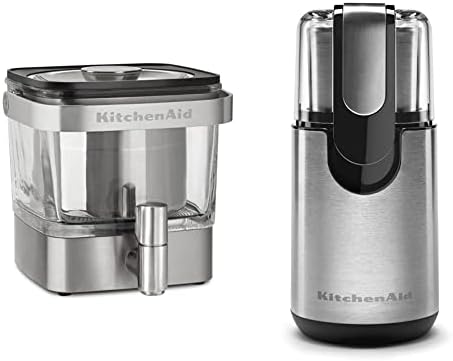
A dedicated brewer with a stainless steel filter and a built in tap, aimed at people who want cold brew as an appliance rather than a project. It sits at the premium end; see our KitchenAid cold brew coffee maker review.
Brewing and Storing It Well
Cold brew is forgiving, which is exactly why small habits show up in the glass. Weigh your coffee instead of scooping it, stir at the start so no dry clumps float on top, then leave it alone in the fridge.
When time is up, strain and get the grounds out immediately, because coffee left sitting in finished brew keeps extracting and turns heavy. Store it sealed in the fridge and drink ready to drink batches within about a week. For the coffee shop finish on top, see our guide to the best milk frothers for cold foam.
Common Mistakes to Avoid
- Grinding too fine. Pour over grind turns a long steep muddy and clogs the filter. Go coarse to extra coarse.
- Buying a carafe you never measured. Tall brewers and short fridge shelves are the most common regret here.
- Confusing concentrate with a finished drink. Undiluted concentrate over ice is an unpleasant surprise. Check which one your brewer makes.
- Leaving the grounds in after steeping. Extraction does not stop when the timer does. Strain on schedule and lift the basket right away.
- Neglecting a cloth filter. Felt filters need rinsing and storage in water in the fridge, or they pick up stale flavors fast.
Where to Go From Here
Settled on a system but not a model? The reviews are where the trade-offs live: the OXO and Takeya pitchers for everyday immersion, the Toddy system for concentrate in volume, the KitchenAid for an appliance rather than a project.
And if this is your entry into brewing at home, cold brew pairs naturally with a hot method for winter mornings. Start with our guide to the best pour over coffee makers: same beans, same scale, different grind, far less waiting.
Frequently Asked Questions
How long should cold brew steep? Commonly 12 to 24 hours. Shorter steeps taste lighter and sweeter, longer ones heavier, and fridge brewing generally takes longer than room temperature. Start around 16 hours and adjust.
What grind size do I need for cold brew? Coarse to extra coarse is commonly recommended. Fine particles make the cup heavy and cloudy and clog filters, which is why consistency matters, as covered in our cold brew grinder guide.
Is cold brew the same as iced coffee? No. Iced coffee is brewed hot and chilled, while cold brew is extracted with cold water over many hours. Most people describe cold brew as smoother and less bitter.
Do I need concentrate or ready to drink? Ready to drink is simpler, since you pour it over ice. Concentrate is stronger, stores in less fridge space, and mixes to taste. Bucket systems make concentrate, pitchers usually make ready to drink.
Can I use a French press for cold brew? Yes. The mesh lets more sediment through and the seal is not airtight for storage, but as a way to test the method before buying anything it works fine.
The Bottom Line
Pick the system before the product: an immersion pitcher for everyday simplicity, a bucket and cloth setup for concentrate by the batch, an accelerated machine if overnight is the dealbreaker. Then get the grind coarse and the batch size honest about how much you drink. Those two checks fix nearly every cold brew disappointment.