Last updated: August 11, 2026
Search for Breville espresso machine cleaning tablets and you land in a small pile of similar looking products: tablets, powders, descaler sachets, filter cartridges, and a rubber disc that came in the box and has been in a drawer ever since. They are not interchangeable, and buying the wrong one is the reason so many owners run a cycle and watch the warning light stay exactly where it was.
The fix is understanding that a Breville machine asks for three separate maintenance jobs, each with its own product and its own rhythm. Once you can tell coffee oil from mineral scale from water treatment, the shopping list gets short and the machine stops nagging. This guide sorts the three jobs, explains how the cleaning cycle works in general terms, and points to the supplies that keep the routine going.
This article contains affiliate links. If you buy through them, we may earn a commission at no extra cost to you. Learn more.
Quick Answer
What do Breville cleaning tablets actually do, and what else do you need?
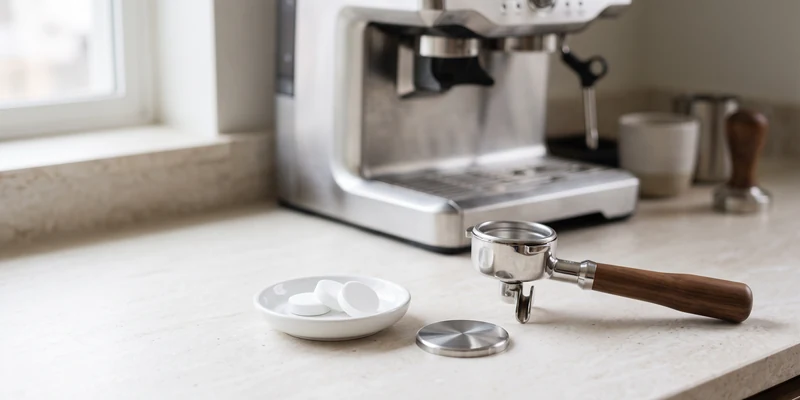
- Cleaning tablets dissolve coffee oils in the group head and shower screen. They go in the blind disc inside the portafilter, never in the water tank.
- Descaler is a different product for a different problem: mineral scale in the water path. A cleaning tablet will not touch it.
- Water filters in the tank do not clean anything, they slow how quickly scale forms, which is why they get replaced on a schedule of their own.
Three Jobs, Three Products
Almost every maintenance question about these machines resolves once you separate the three tasks. Coffee oils, mineral scale, and water treatment are unrelated problems that happen in different parts of the machine, and each has a product built for it.
| Task | What it removes | What you need | Typical rhythm |
|---|---|---|---|
| Cleaning cycle | Coffee oils and fine grounds in the group head and shower screen | A cleaning tablet plus the blind disc in the portafilter | When the machine’s clean indicator appears, based on shots pulled |
| Descaling | Mineral scale in the tank, pump, boiler, and outlets | Descaling powder or liquid, run through the machine’s descale mode | When the descale indicator appears, driven by usage and water hardness |
| Water filtration | Nothing directly, it slows scale from forming | A replacement filter cartridge for the water tank | On the interval printed in your manual, sooner in hard water |
| Daily basics | Loose grounds, milk residue, tray water | A brush, a cloth, and the steam wand routine from the manual | Every session |
If the light on your machine is the descale indicator rather than the clean indicator, tablets are the wrong purchase and our walkthrough of how to descale a Breville espresso machine is the page you actually want.
How the Cleaning Cycle Works
The cleaning cycle exists because espresso is oily. Every shot leaves a thin film of coffee oil behind in the group head and on the shower screen, and over weeks that film turns rancid and starts showing up in the cup as a stale, slightly bitter edge that no change of beans will fix. The tablet dissolves that film with pressurized water doing the scrubbing.
In general terms, the routine looks the same across models: you drop a cleaning tablet into the blind disc, the solid rubber insert that blocks water from escaping, seat that in the portafilter, lock it into the group, and start the machine’s cleaning function. Because the disc has no holes, water pressure backs up and pushes the solution through the parts that normally only see flow going one direction. Your manual gives the exact button sequence, the tablet count, and the rinse steps for your machine, and those details do vary between models.
Why the Tablet Never Goes in the Water Tank
It is an easy mistake, and it is worth calling out plainly: cleaning tablets are formulated for the coffee path and belong in the blind disc. Dropping one into the water tank sends it through the pump and boiler, which is the descaler’s territory, not the tablet’s. Manufacturers are consistent on this point, and so is the general advice from technicians.
The same logic rules out improvised substitutes. Dish soap, general purpose cleaners, and bleach have no place in any part of a machine that brews into your cup, and they can leave residue that takes many cycles to rinse out. Stick to products sold for espresso equipment, and rinse thoroughly whichever one you use.
Our Top Picks at a Glance
How we chose: we compared the maintenance supplies widely available for Breville machines on compatibility with the manufacturer’s own procedures, availability in the US, and how well each one fits a routine you can actually keep up. Selections lean on product documentation and the patterns that repeat across owner feedback rather than any hands-on trial of our own.
One reassurance before the list: none of these require you to open the machine or go beyond what the manual describes. They are consumables for cycles the machine already runs by itself.
🧼 Best Overall
The manufacturer’s own cleaning tablets, sized for the blind disc that came with your machine and matched to the cleaning cycle in the manual. The straightforward choice when you want zero doubt about compatibility, and a tub lasts a long time at one tablet per cycle.

💧 Essential Companion
Replacement water filter cartridges for the tank. They do not clean anything on their own, but they slow how fast scale forms, which means fewer descale cycles and less strain on the water path over the machine’s life.

🧴 Best for Deep Cleaning
A professional grade espresso cleaner in tablet or powder form, the kind used behind cafe counters for backflushing and for soaking portafilters and baskets. Useful when a machine has gone a while without attention, or when you want one product that covers the soak as well as the cycle.

Also Worth Having: Descaler and a Spare Blind Disc
Two more items round out the drawer. One handles the job tablets cannot touch, and the other is the small rubber part that everyone eventually loses.
🪨 Best Descaler Pairing
Descaling powder made for espresso machines, used in the machine’s descale mode when that indicator appears. This is the mineral scale side of maintenance, and it is a separate cycle with separate steps, laid out in our Breville descaling walkthrough.

⚫ Also Great
A replacement blind disc, sometimes sold as a backflush basket or cleaning disc, in the size that fits a 54mm Breville portafilter. Cheap, easy to misplace, and the cleaning cycle simply does not work without one. Check the size against your portafilter before ordering.

Water Filters: The Part That Saves You Work
Filters are the least exciting item on the list and the one that changes your maintenance load the most. By reducing the minerals that reach the boiler, a filter stretches the interval between descale prompts. That is the whole pitch, and in a hard water area it is a meaningful one.
Two habits make them worth the money. Replace on the schedule in your manual rather than when you remember, since a saturated cartridge stops helping, and take the filter out of the tank before any descaling cycle so the descaler works on the machine instead of the cartridge. If you are not sure how hard your water is, a test strip or your municipal water report will tell you, and it is also the number the machine wants during setup.
Building a Routine You Will Actually Follow
The machine does most of the scheduling for you, which is the point of the indicators. When the clean light appears, run a tablet through the cycle. When the descale light appears, run the descale mode. Replace the filter on the calendar interval. Everything else is daily habit: purge the group briefly before locking in the portafilter, wipe the steam wand and purge it after every milk drink, knock out and rinse the basket, and empty the drip tray before it announces itself.
A monthly soak is the one extra worth adding. Dropping the portafilter basket and the naked portafilter body, without any plastic or electrical parts, into a solution of espresso cleaner lifts the buildup that cycles alone leave behind. Follow the product’s instructions for concentration and soak time, rinse everything thoroughly, and let it dry before the next shot. If milk drinks are a daily habit, the same attention applies to your frothing gear, as covered in our Breville milk frother review.
Where Maintenance Should Stop
Everything described here happens from the outside of the machine: the portafilter, the group face, the tank, the tray, and the machine’s own menu. Keep it that way. An espresso machine holds mains voltage, a heating element, and a pressurized circuit behind its housing, so do not unscrew panels, remove the casing, or try to reach the pump, boiler, or wiring. Beyond the obvious risk, opening the machine can void a warranty that would otherwise cover a repair.
Always work with the machine switched off and cooled down, and follow the manual for anything involving the shower screen or group seals on your specific model. If a cleaning cycle does not resolve poor flow, or if the machine behaves oddly afterward, unplug it and contact Breville support with your model details rather than investigating inside.
Common Mistakes to Avoid
- Putting a cleaning tablet in the water tank. Tablets belong in the blind disc in the portafilter. The tank is descaler territory.
- Treating tablets and descaler as the same thing. One removes coffee oils, the other removes mineral scale. Running the wrong cycle leaves the indicator lit.
- Skipping the rinse. After any cleaning cycle, flush the group with plain water and pull one shot you pour away before you brew for real.
- Leaving the filter in during descaling. The cartridge absorbs what the descaler is meant to carry away. Remove it first, reinstall it after.
- Using dish soap or household cleaners. They are not formulated for the coffee path and can leave residue that takes many cycles to clear.
- Waiting for a taste problem before cleaning. By the time stale oils show up in the cup, they have been building for a while. The indicators exist so you do not have to rely on your palate.
Where to Go From Here
If your machine is currently asking for descaling rather than cleaning, start with the step by step Breville descaling guide, then use the descaling solutions roundup to pick a product that suits your water and your machine. If you are still weighing which Breville to buy, or whether to upgrade an aging one, the Breville espresso machine guide compares the range. And once maintenance is handled, the next improvement in the cup usually comes from consistency at the puck, which is where a correctly sized espresso tamper does more than it looks like it should.
Frequently Asked Questions
Can I use any brand of cleaning tablet in a Breville? Tablets made for espresso machines are widely used across brands, provided they fit the blind disc and you follow the dosing on the packaging. The manufacturer’s own tablets remove any doubt about sizing and compatibility with the cycle.
How often should I run the cleaning cycle? Let the machine tell you. The clean indicator is based on shots pulled, so a heavy household reaches it faster than an occasional one. Your manual states the count and the procedure for your model.
Do cleaning tablets remove limescale? No. Tablets work on coffee oils in the brew path, while scale in the water path needs a descaler and the machine’s descale mode, as covered in our descaling guide.
What is the blind disc for? It is a solid insert with no holes that goes in the portafilter basket. Blocking the outlet lets pressure build so the cleaning solution reaches parts a normal shot never touches. Without it, the cycle cannot do its job.
Do I really need the water filter? It is optional but useful, especially in hard water areas, because it slows scale formation and stretches the interval between descale cycles. Replace it on schedule and take it out before descaling.
Can I soak the portafilter in cleaner? Metal baskets and the portafilter body are commonly soaked in espresso cleaning solution following the product’s instructions. Keep plastic handles, gaskets, and anything electrical out of the solution, and rinse everything thoroughly afterward.
The Bottom Line
Breville cleaning tablets handle one specific job, dissolving coffee oils in the group head during the cleaning cycle, with the tablet seated in the blind disc rather than the water tank. Scale is a separate problem that needs a descaler and the machine’s descale mode, and water filters sit alongside both to slow scale from forming at all. Keep one of each in the cupboard, follow the indicators, and the machine mostly maintains itself.