Last updated: August 12, 2026
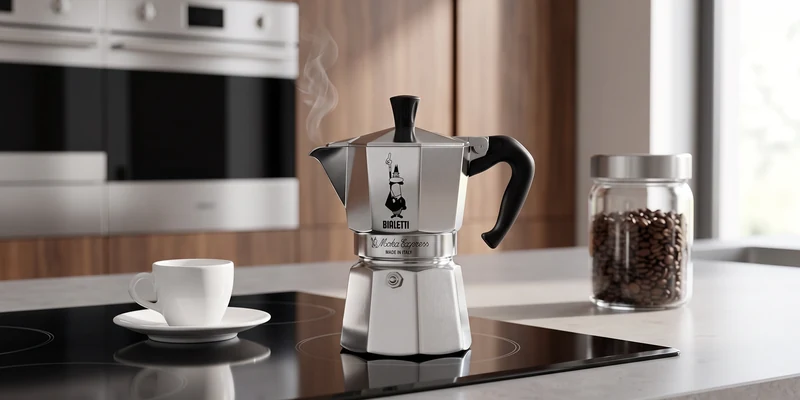
The Bialetti Moka Express is the eight-sided aluminum pot you have seen on a thousand Italian stovetops, in film sets, and in design museum cases. Alfonso Bialetti introduced it in 1933, the shape has barely changed since, and the little mustachioed man printed on the side has been the brand’s mascot since the 1950s. The 3-cup version is the one most Americans buy first, usually because it looks right and costs less than a bag of specialty beans.
This review looks at the 3-cup Moka Express the way a careful buyer would: what it genuinely does well, where the aluminum construction sets limits, whether the sizing means what you think it means, and who should buy a different pot instead. It is an assessment of specifications and owner feedback patterns, not a hands-on lab test.
This article contains affiliate links. If you buy through them, we may earn a commission at no extra cost to you. Learn more.
Quick Answer
Is the Bialetti Moka Express 3-cup worth buying?
- Yes, if you want strong, concentrated stovetop coffee for one person and you cook on gas or electric. It is inexpensive, nearly indestructible, and the design has survived ninety years for good reasons.
- Understand the sizing: three moka cups is roughly four ounces total, so it fills one small mug, not three.
- Skip it if you have an induction cooktop or want to put it in the dishwasher. Aluminum does neither, and Bialetti’s own stainless line exists for exactly that reason.
Bialetti Moka Express at a Glance
The Moka Express is a two-chamber stovetop brewer: water in the bottom, ground coffee in a funnel basket, and steam pressure pushing the brew up a central column into the top.
| Category | What to know |
|---|---|
| Design | Faceted eight-sided aluminum body, introduced by Alfonso Bialetti in 1933 and largely unchanged since |
| Material | Cast aluminum body and boiler, with a heat-resistant handle and knob |
| Brewing pressure | Steam pressure in the low single digits, generally described as roughly one to two bar |
| 3-cup capacity | Three small Italian-style servings of roughly two ounces each, so about one modest mug in total |
| Cooktops | Gas, electric, and ceramic. Not induction, because aluminum is not magnetic |
| Cleaning | Hand wash with hot water; detergent and dishwashers are not recommended for aluminum |
| Consumables | Gasket and filter plate are replaceable and widely sold for every size |
| Ideal for | Solo drinkers, milk drinks, cafecito, and anyone who wants strong coffee without electricity |
| Less ideal for | Induction kitchens, dishwasher households, and anyone expecting true espresso |
What the Moka Express Gets Right
Simplicity is the headline. There is nothing to break: three parts, a gasket, and a filter plate, all replaceable for pocket change. Owners routinely describe pots that have been in service for a decade or more, and the only maintenance is a new gasket every so often. For a coffee brewer, that is an unusual value proposition, and it is the main reason the design outlived nearly everything else from 1933.
The coffee is the second strength. A moka pot produces a small, concentrated, low-acid cup with real body, the kind that takes milk without disappearing. It is the natural base for a Cuban cafecito, for a homemade cappuccino, or for a short black coffee with a spoon of sugar. Aluminum also heats fast, so the 3-cup comes up to brewing temperature in a couple of minutes on a modest flame, and the whole ritual is over in about five. The pot’s cultural weight is real too: it is a fixture of Italian home life, a design icon held in museum collections, and the Bialetti family’s attachment to it went far enough that when Renato Bialetti died in 2016, his ashes were placed in a giant version of the pot.
Where the Moka Express Falls Short
Aluminum is the source of every real limitation. It will not work on an induction cooktop at all, because induction hobs need a magnetic base, and no amount of technique gets around that. It should not go in a dishwasher or meet detergent, since both dull and pit the surface, so the accepted care routine is a hot water rinse and a thorough dry. Over time the interior develops a darkened patina, which most long-time owners consider seasoning and some new buyers find alarming.
The second issue is expectation management. This is not an espresso machine. Brewing at roughly one to two bar against the nine bar of a pump machine means no true crema and a different extraction entirely, so listings that describe it as an espresso maker are stretching the word. There is also no forgiveness built in: too much heat and the finish turns bitter and sputtery, too fine a grind and the pot struggles. The Moka Express rewards a medium-low burner and attention in the last thirty seconds, which is either a pleasant ritual or a chore depending on your morning.
Is the 3-Cup the Right Size?
Moka pot sizing is the single most misunderstood thing in this category. A cup here means a small Italian serving of roughly two ounces, not an American mug, so the 3-cup produces about four ounces of concentrated coffee. That is one modest mug, two proper espresso-sized cups, or the base for one generous milk drink.
The important constraint is that a moka pot must be brewed at its rated capacity. You cannot fill a 6-cup halfway and get a good small brew, because the basket and boiler are matched to each other. So the 3-cup is genuinely the right buy for one person, and households of two or more should look at the 6-cup instead rather than brewing the small one twice. Both sizes are covered below.
Check It Out
How we chose: the standard 3-cup aluminum Moka Express is the configuration most first-time buyers want and the one nearly all owner feedback describes.
🏆 The Stovetop Classic
The original eight-sided aluminum moka pot in its most popular single-serving size. Cheap, repairable, and capable of a genuinely strong cup on any gas or electric burner, with replacement gaskets available anywhere.

Who It Is For, and Who Should Skip It
Buy the 3-cup Moka Express if you drink one strong coffee at a time, cook on gas or electric, and like equipment that has no electronics and no consumable pods. It is also the natural pot for anyone learning to make a Cuban cafecito, because the first dark drops from a moka pot are exactly what you need for whipping espuma, as explained in our Cuban coffee guide.
Skip it if your kitchen has an induction cooktop, if you want to put the pot in the dishwasher, or if you are shopping for what you think is an espresso machine. Skip the 3-cup specifically if more than one person drinks coffee in your house, since underfilling a larger pot is not a workaround.
Alternatives Worth Considering
Three directions, depending on which limitation matters most in your kitchen.
👥 The Same Pot, Bigger
The 6-cup Moka Express is the household size, yielding roughly twelve ounces of concentrated coffee. Identical design and care, and the more sensible buy for two regular drinkers.

🔥 For Induction Kitchens
Bialetti’s stainless line keeps the brewing logic and adds a magnetic base, dishwasher tolerance, and a finish that stays bright. The obvious substitute if aluminum is a non-starter on your cooktop; the full field is in our stainless moka pot guide.

🔧 The Part That Actually Wears Out
Gaskets harden and filter plates clog, and both are the usual reason an older moka pot brews slowly or leaks steam at the seam. A multipack sized for your pot is the cheapest possible fix and worth keeping in the drawer.

Frequently Asked Questions
How much coffee does a 3-cup Bialetti make? Roughly four ounces of concentrated coffee, since a moka cup is about two ounces. That is one small mug or two espresso-sized servings, not three mugs.
Can I use a Bialetti Moka Express on induction? No. The classic aluminum body is not magnetic. You need a stainless model or an induction adapter disk, both covered in our induction moka pot guide.
Does the Moka Express make espresso? Not in the technical sense. It brews at roughly one to two bar rather than the nine bar of a pump machine, so you get concentrated coffee with little true crema.
Can I wash it with soap or in the dishwasher? Neither is recommended for aluminum. Rinse with hot water, dry the parts, and store the pot with the top loosely fitted so the gasket does not compress.
Why is my moka pot brewing slowly or sputtering? Most often a worn gasket, a clogged filter plate, or a grind that is too fine. Replace the gasket first, since it is the cheapest and most likely culprit.
The Bottom Line
The 3-cup Bialetti Moka Express remains the easiest recommendation in stovetop coffee: cheap, repairable, and capable of a strong, milk-friendly cup with nothing but a burner. Just buy it for what it is. Three moka cups is one mug, aluminum rules out induction and dishwashers, and the result is concentrated coffee rather than espresso.